Yoga means "union." What follows is the actual architecture of the tradition — far richer than anything a yoga studio ever explained.
Around 400 CE, the sage Patanjali codified yoga into 196 aphorisms. The eight limbs (Ashtanga) form a complete map from ethics to enlightenment. Yogananda claims Kriya Yoga encompasses all eight in a single practice.
Ahimsa (non-violence) · Satya (truthfulness) · Asteya (non-stealing) · Brahmacharya (wise use of energy) · Aparigraha (non-possessiveness). The foundation. Without these, the rest doesn't work — it's like building a house on sand.
Saucha (purity) · Santosha (contentment) · Tapas (austerity/discipline) · Svadhyaya (self-study) · Ishvara pranidhana (surrender to the Divine). The internal character work that prepares the practitioner.
Originally: simply a stable, comfortable seated position for meditation. The elaborate physical practice of modern yoga came much later. Patanjali devotes exactly three sutras to this limb. The point is a steady body that doesn't distract the mind during meditation.
Breath regulation as a gateway to controlling prana (life energy). This is where Kriya Yoga lives. The breath and the mind are intimately linked — control the breath, and the mind follows. This is the hinge between the external limbs (1–3) and the internal limbs (5–8).
Drawing the senses inward — disconnecting from external stimuli. Like a tortoise pulling its limbs into its shell. In Kriya practice, this happens naturally as prana is withdrawn from the sensory nerves and redirected toward the spine and brain.
Fixing the mind on a single point — the breath, a mantra, a chakra, the space between the eyebrows (ajna). Most meditation struggles happen here: the mind wanders, you bring it back. The training ground for what comes next.
Sustained, unbroken awareness — when concentration becomes effortless and the meditator and the object of meditation begin to merge. This is what people mean when they say they were "in the zone." The difference between trying to meditate and actual meditation.
Complete merger. The subject-object distinction dissolves. The meditator disappears into the object — and eventually into pure consciousness itself. This is the goal. Not an experience you have; a state you become. See below for the stages of Samadhi.
Different temperaments require different approaches. All roads lead to the same mountain. Yogananda taught a synthesis with Kriya as the central technique.
The path of devotion and love. Chanting, prayer, worship — surrendering the heart to the Divine. For those who find it natural to love deeply. Yogananda embodied this through his devotional singing (kirtan) and relationship with his guru.
The path of knowledge and discrimination. "Not this, not this" — systematically eliminating everything that isn't the eternal Self until only pure awareness remains. For those with philosophical temperament. Requires extraordinary honesty.
The path of selfless action. Do your work fully and well, without attachment to outcomes. The Bhagavad Gita's central teaching. Every action as an offering. For those who are doers by nature.
"Royal yoga" — Patanjali's system. The path of meditation and mind control. The science of consciousness. Kriya Yoga is a form of Raja Yoga. For those drawn to direct investigation of mind and awareness.
Working with the dormant spiritual energy at the base of the spine. Powerful and potentially destabilizing without proper guidance. Kriya Yoga, in Yogananda's teaching, offers a safe, gradual awakening of this energy through the guru-disciple channel.
Balancing solar and lunar energies (ha = sun, tha = moon) through physical practices. The precursor to modern yoga studios. Originally a preparation for meditation, not an end in itself. Useful for purifying the body and calming the nervous system.
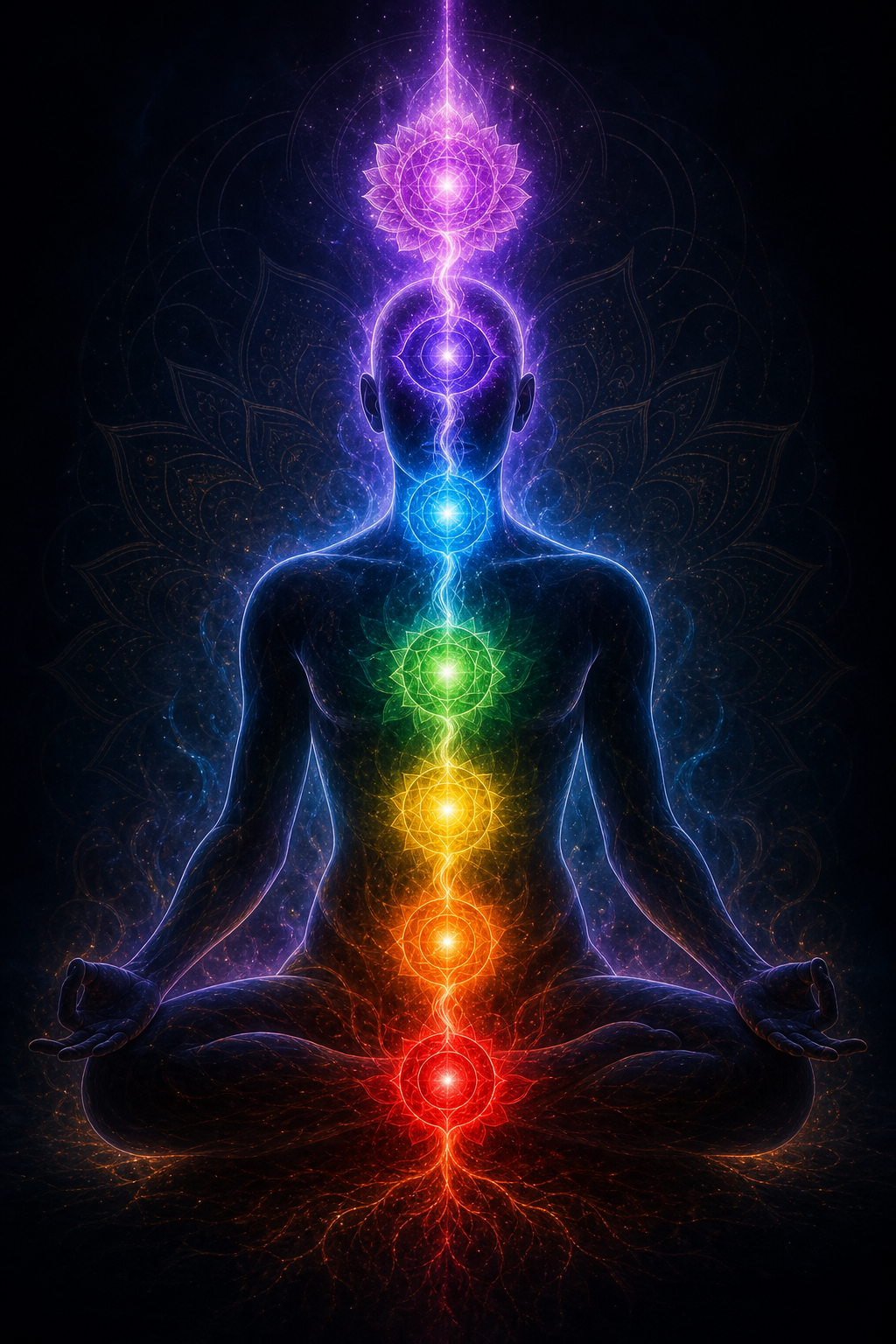
In yogic anatomy, the subtle body has seven primary energy centers (chakras) along the spine. Kriya Yoga works by consciously directing prana through these centers, awakening and purifying each one.
During Kriya practice, the yogi directs prana (life energy) upward along the spine on the inhalation, briefly holding awareness at each chakra, then downward on the exhalation. Over time, this "magnetizes" the centers, awakening latent capacities — heightened intuition, deeper compassion, expanded awareness — at each level.
The upward movement withdraws energy from lower (survival/desire) concerns and elevates it toward higher (love/wisdom/consciousness) functions. It's an inner evolution — literally.
Kundalini is described as a coiled serpent of spiritual energy lying dormant at the base of the spine (Muladhara). When awakened through sustained yogic practice, it rises through the central spinal channel (Sushumna nadi), piercing each chakra in sequence, until it reaches the crown (Sahasrara) and merges with pure consciousness.
This awakening is described as the most dramatic possible inner experience — light, bliss, energy, dissolution of personal identity. It can also be destabilizing if it happens prematurely or without guidance.
He described Kriya Yoga as a safe, guided method for awakening Kundalini — as opposed to forced techniques that can cause "psychic disorder, melancholia, or insanity." The guru's transmitted grace acts as a protective channel.
Meditative absorption with subtle distinction remaining. The soul feels united with the Divine but maintains a faint sense of being a separate experiencer. Like being dissolved in the ocean but still knowing you were once a drop.
Thoughtless, pure absorption. Complete merger. No "I" remains to observe — only infinite, undifferentiated consciousness. The ego is completely transcended. Yogananda described entering this state regularly.
The yogi's final, conscious exit from the physical body at death. Distinct from ordinary death in that it is chosen, peaceful, and preceded by a period of heightened awareness. Yogananda entered Mahasamadhi in 1952 in full public view.
No notes yet.
Jot down thoughts as you explore.