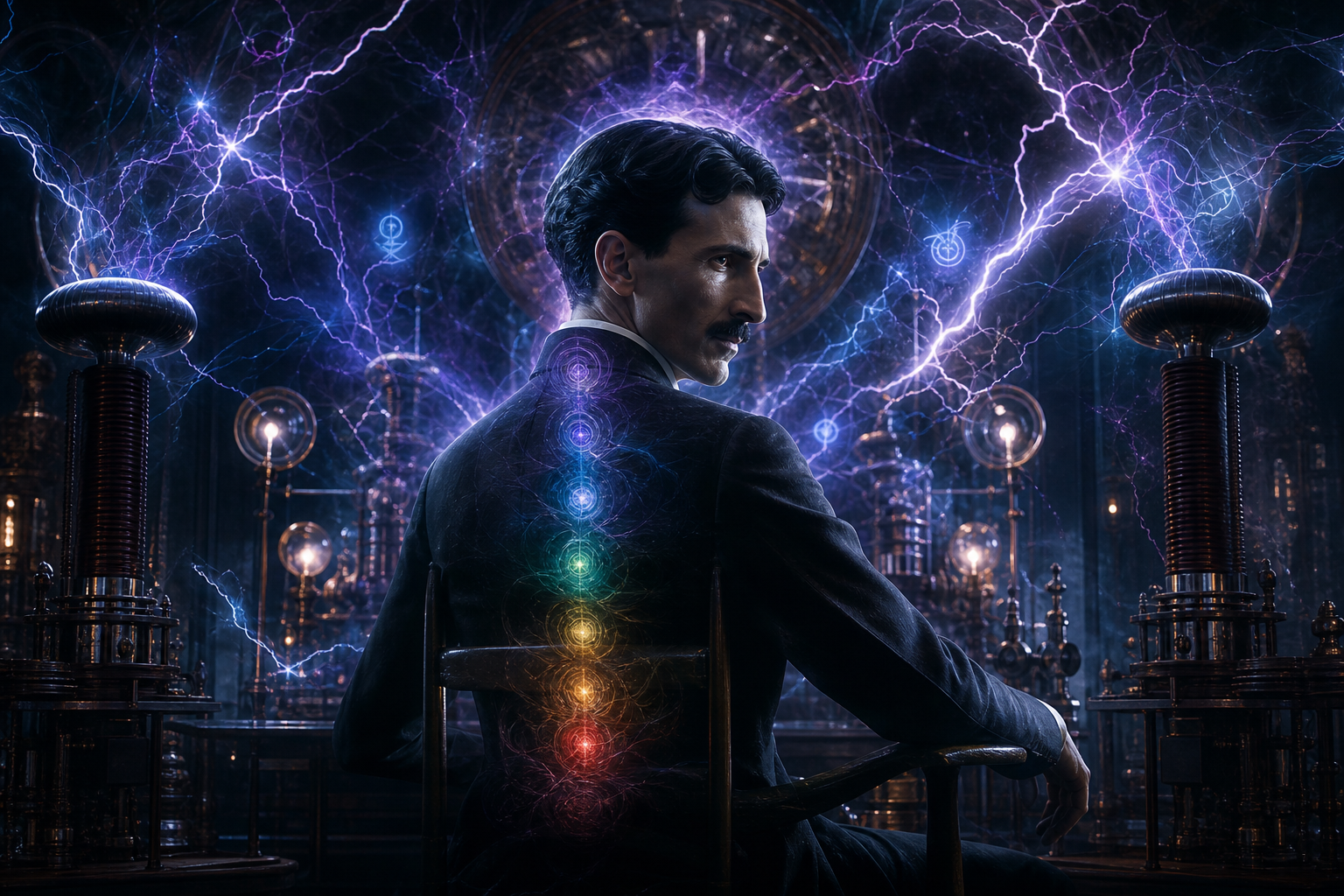
"If you want to find the secrets of the universe, think in terms of energy, frequency and vibration."
— Nikola Tesla · This is not engineering. It is yogic cosmology.
Tesla Meets Vivekananda
Two of the greatest minds of the 19th century meet at the intersection of science and mysticism.
The Meeting of Two Minds
Swami Vivekananda — who had already transformed Western spiritual understanding with his 1893 Parliament of Religions address — recognized in Tesla a kindred spirit. He saw in Tesla's work on energy and vibration a scientific validation of ancient yogic principles. The monk from Calcutta and the inventor from Serbia found themselves speaking the same language in different vocabularies.
⚡ The Matter-Energy Challenge
Vivekananda challenged Tesla to prove that matter is condensed energy — years before Einstein's E=mc² (1905). Tesla reportedly worked on this problem and came close, but could not complete the formal proof to his satisfaction. Vivekananda's intuition was correct. Tesla's inability to formalize it may have been due to the limitations of 19th-century mathematics, not conceptual error.
The meeting's legacy was concrete: after 1896, Tesla's writings began incorporating Sanskrit terminology — particularly Akasha (the fundamental medium of existence) and, implicitly, Prana (the life force that flows through it). He was not borrowing exotic vocabulary for effect. He believed these ancient concepts described the same realities his instruments were measuring.
Akasha and Prana
🌌 Akasha (Ether/Space)
In yogic cosmology, Akasha is the subtlest of the five elements (pancha mahabhuta). It is space itself — the medium in which all other elements exist, the field of potentiality from which all manifestation emerges.
Tesla's "ether" was not the discredited luminiferous ether of 19th-century physics. It was closer to the yogic Akasha: a fundamental, all-pervading medium that could be manipulated through resonance and vibration. He believed unlimited energy could be extracted by tuning into its resonant frequencies.
⚡ Prana = Electrical Energy?
Tesla explicitly explored the parallel between electrical energy (his domain of mastery) and Prana — the yogic life force that animates living systems, runs through the nadis, and powers the practice of pranayama.
He wrote about electrical oscillations potentially interacting with the "vital force" of living systems. He saw electricity not merely as a physical phenomenon but as a bridge between the gross material world and the subtle energies described in yogic texts.
| Yogic Concept | Tesla's Framework | Modern Science |
|---|---|---|
| Akasha — the fundamental medium, all-pervading space | The "ether" — a medium for electromagnetic waves, the substrate of reality | Quantum vacuum / zero-point energy field |
| Prana — life force, vital energy, flows through all living things | Electrical life energy — the current that animates both machines and organisms | Bioelectricity, electromagnetic biofields |
| Spanda — primordial vibration, the pulse of manifestation | Resonance and frequency — everything vibrates, all matter is vibration | String theory / quantum vibration |
| Nada — the cosmic sound, vibration as creative principle | Standing waves — the geometry of frequency creates form | Cymatics, wave-particle duality |
Tesla's Ascetic Life
Tesla didn't just think like a yogi. He lived like one.
Brahmacharya
Tesla practiced strict celibacy throughout his life. In yogic terms this is brahmacharya — the conservation and transmutation of sexual energy (ojas) into intellectual and spiritual power.
He believed sexual energy, when conserved and redirected, could fuel exceptional creative and mental work. This was not puritanical repression but deliberate energetic management — a concept central to both hatha and tantra yoga.
Vegetarian Asceticism
Tesla was a vegetarian who ate sparingly. His daily routine was rigorous:
- 4–5 hours of sleep
- Long walks for contemplation and mental processing
- Intense periods of focused work (tapas)
- Minimal social engagement — protecting inner space
- No alcohol, minimal food, no attachments to possessions
Tapas and Dharana
Tesla's legendary work habits were yogic discipline by another name:
- Worked for days without rest during moments of creative fire
- Maintained precise mental models of entire inventions
- Could "run" machines in his mind, checking for wear and malfunction, before building them
- This is not workaholism — it is dharana (total concentration) sustained over time
Visualization as Yogic Siddhi
The Inner Laboratory
From childhood, Tesla could visualize with photographic clarity. He described imagining entire inventions in three dimensions, rotating them mentally, running them at full speed, checking components for stress and wear — all without touching a physical object. He would build entire prototypes in his mind before picking up a tool.
In yogic terms, this is the perfection of pratyahara (withdrawal of senses from external objects) leading to dharana (concentration) and dhyana (meditation). The inner space becomes as vivid as the outer world — more vivid, in Tesla's case.
"I do not rush into actual work. When I get an idea, I start at once building it up in my imagination. I change the construction, make improvements and operate the device in my mind. It is absolutely immaterial to me whether I run my turbine in my mind or in my shop. The inventions I have conceived in this way have always worked." — Nikola Tesla
⚡ The Flash of Light Experiences
Tesla described moments of sudden illumination:
- A flash of brilliant light would appear before his eyes
- In that moment, the solution would arrive fully formed — complete, detailed, functional
- He felt he was receiving knowledge rather than generating it
- The knowledge felt external — as if tapping into a field of information that pre-existed his asking
The Jnana Parallel
This is strikingly similar to descriptions of jnana (direct knowing) in yogic traditions — knowledge received in a flash from a source beyond the individual mind. The yogic concept of the Akashic records (the subtle impression of all events and knowledge in the ether) suggests that advanced meditators can access information non-locally. Tesla's "flashes" fit this model precisely.
369 and Yogic Numerology
Tesla's obsession with 3, 6, and 9 has deep parallels in ancient yogic and tantric traditions.
"If you only knew the magnificence of the 3, 6 and 9, then you would have a key to the universe." — Nikola Tesla
Tesla's Pattern Recognition
- 3 + 6 + 9 = 18 → 1 + 8 = 9
- All multiples of 9 reduce to 9 (digital root property)
- In vortex math: 3-6-9 stand apart from the material doubling circuit (1-2-4-8-7-5)
- 3, 6, 9 form a "control system" — the spine of the geometric structure of the doubling
- Tesla circled buildings 3 times, only stayed in hotel rooms with numbers divisible by 3
Yogic / Tantric Significance
- 3: The three gunas (sattva, rajas, tamas) — fundamental qualities of all nature
- 6: Ajna chakra (the sixth, the third eye); six directions of space; six seasons of Indian calendar
- 9: Navagraha (nine planets); Navadurga (nine forms of the Goddess); nine openings of the body
- 9 as completion and return — in Sanskrit, nava means both "nine" and "new"
Independent Discovery or Transmission?
Whether Tesla consciously connected his number obsession to yogic numerology is unclear — though his meeting with Vivekananda gives reason to suspect some cross-pollination. The more striking possibility: Tesla may have independently rediscovered numerical patterns that ancient traditions encoded symbolically. The same deep structure of reality, approached from different angles of inquiry, producing the same patterns.
Was Tesla a Yogi?
🧘 The Yogic Interpretation
Tesla exhibited the classic signs of advanced sadhana:
- Brahmacharya — conserved energy for higher functioning
- Tapas — disciplined austerity and relentless focus
- Vivid visualization — cultivated inner sight (antar drishti)
- Receptivity — "receiving" knowledge in sudden flashes of illumination
- Akasha awareness — direct intuition of the subtle medium
- Non-attachment — died alone, without possessions or family
🔬 The Scientific Interpretation
From a materialist view:
- Brilliant pattern recognizer with an extraordinary visual processing capability
- Creative insights emerging from subconscious integration of known information
- Asceticism was a personal choice that happened to support his work
- The 369 obsession was a quirk of an autistic-spectrum mind finding comfort in pattern
- Akasha and Prana were metaphors, not literal descriptions of physical phenomena
The Synthesis
Both perspectives may be true simultaneously. Tesla's disciplined lifestyle created the conditions for genuine insight — whether one understands that as grace, subconscious processing, or access to subtle fields of information is a matter of metaphysics, not observation.
What is clear: Tesla lived like a yogi, thought like a mystic, and worked like a scientist. He occupied the intersection of these domains in a way few have before or since. He was, at minimum, living proof that the yogic lifestyle produces extraordinary cognitive and creative capacity — regardless of how one interprets the mechanism.
"The day science begins to study non-physical phenomena, it will make more progress in one decade than in all the previous centuries of its existence."
— Nikola Tesla
This statement, more than any other, reveals Tesla's yogic soul.