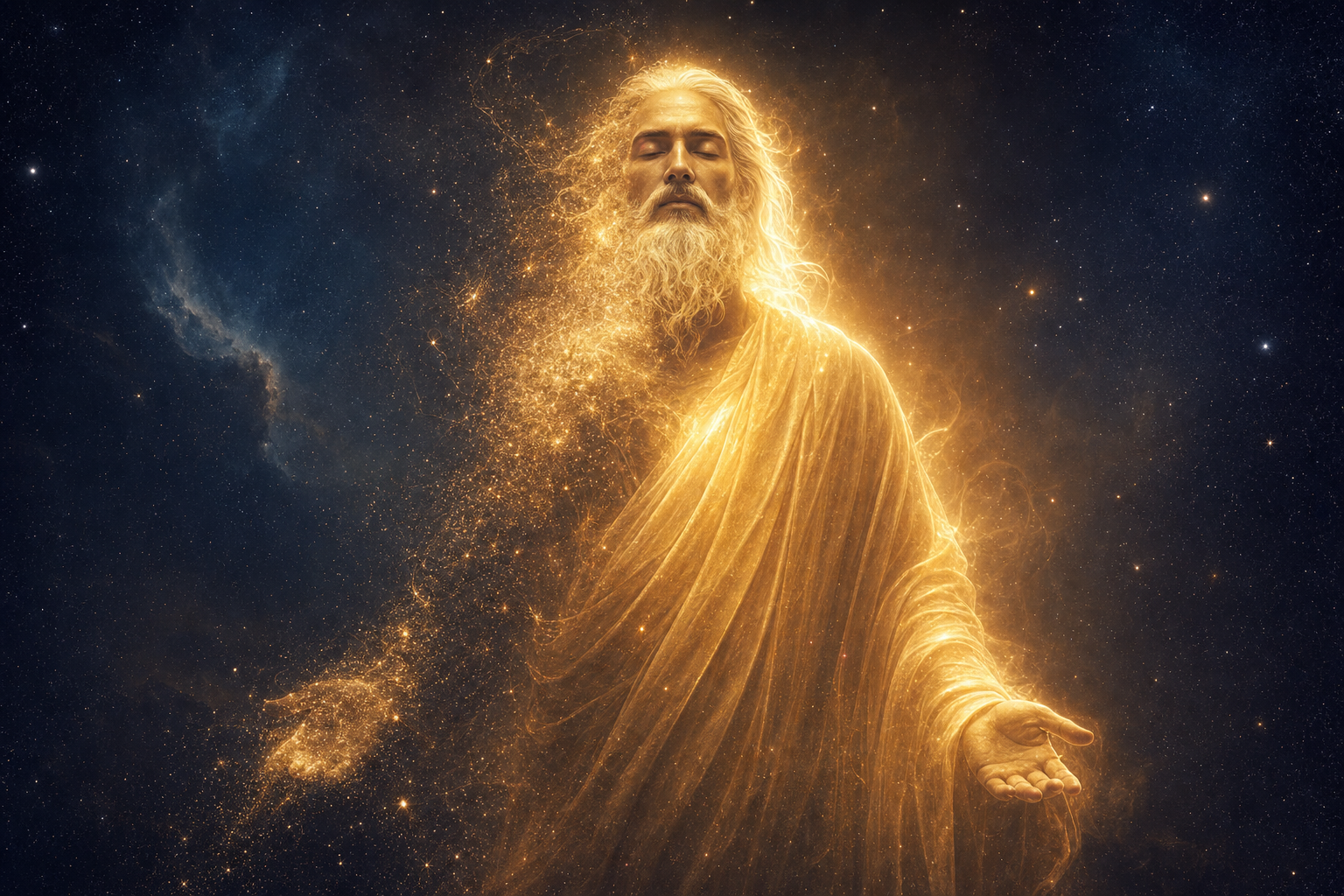
Sri Yukteswar died in March 1936. Three months later, he materialized in Bombay in a flesh-and-blood body and spent an afternoon explaining exactly what happens after death. This is the most detailed firsthand account in yogic literature.
Three months after his death and burial at Puri, Sri Yukteswar appeared to Yogananda in a hotel room. Not a vision. Not a dream. A tangible, physical encounter.
It was 3:00 PM at the Regent Hotel. Yogananda had just returned from the Kumbha Mela pilgrimage and was sitting alone when his guru appeared — not as a ghost or a mental impression, but as a solid, breathing man he could embrace.
Yogananda was stunned. He grabbed his master with what he later called an "octopus grip," overwhelmed by grief, joy, and confusion collapsing into one. He could smell that same faint, fragrant natural odor he remembered from his guru's living body.
Sri Yukteswar calmly explained: he hadn't returned to the physical earth. He had materialized a new body — one that looked and felt physical to Yogananda's senses, but was actually a subtly constructed astral form created from cosmic atoms. He was, in truth, resurrected — but on an astral planet, not this one.
This event is the foundation of Chapter 43 — arguably the most extraordinary chapter of Autobiography of a Yogi. What follows is not speculation or philosophy. It's a direct report from someone who had already crossed the threshold.
"This is a flesh and blood body. Though I see it as ethereal, to your sight it is physical. From the cosmic atoms I created an entirely new body, exactly like that cosmic-dream physical body which you laid beneath the dream-sands at Puri." — Sri Yukteswar to Yogananda
"I am in truth resurrected — not on earth but on an astral planet. Its inhabitants are better able than earthly humanity to meet my lofty standards. There you and your exalted loved ones shall someday come to be with me." — Sri Yukteswar
Sri Yukteswar explained that consciousness inhabits three distinct realms — each subtler and more expansive than the last. Every soul carries three bodies, one for each world.
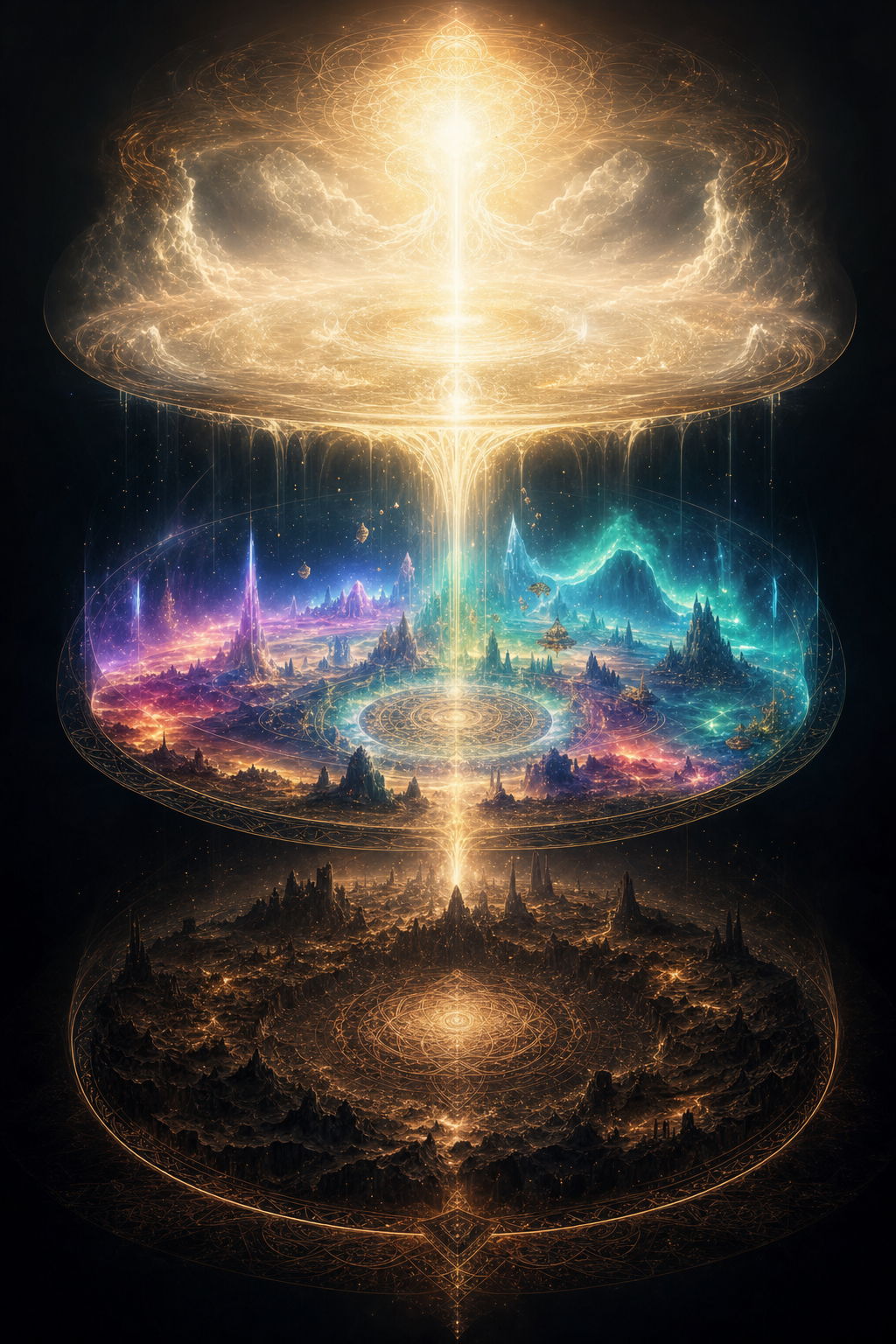
The three realms: Physical (bottom), Astral (middle), Causal (top) — from dense matter to pure light
The dense material universe we inhabit now. Governed by maya — the cosmic delusion that makes everything feel solid, separate, and permanent. Subject to disease, old age, death, war, and natural disaster.
Body: 16 physical elements. Senses: 5 gross senses.
Think of it as: the outermost shell of a Russian nesting doll.
Hundreds of times larger than the material cosmos. Made of subtle vibrations of light and color. Beings here travel by thought, manifest objects by will, and communicate through pure telepathy. No disease, no aging, no death by accident.
Body: 19 astral elements — mental, emotional, and lifetronic.
Think of it as: the middle world, far more free than this one.
The realm of pure ideas. Beings here exist as individualized souls in a matrix of thought — no need for food, sensation, or even an astral form. The causal body is the original template from which astral and physical bodies are projected.
Body: 35 causal ideas — the seed-template for all lower manifestation.
Think of it as: the blueprint behind the blueprint.
Your physical body = 16 elements.
Your astral body wraps the physical: 16 + 19 = 35 elements.
Your causal body is the idea-seed for all of it: 35 causal ideas contain the template for everything below.
Liberation = releasing all three. Until then, you cycle through the worlds.
Sri Yukteswar described the astral world in astonishing detail. It's not a vague "heaven." It has planets, seasons (eternal spring), food, travel, social life, and even its own form of death.
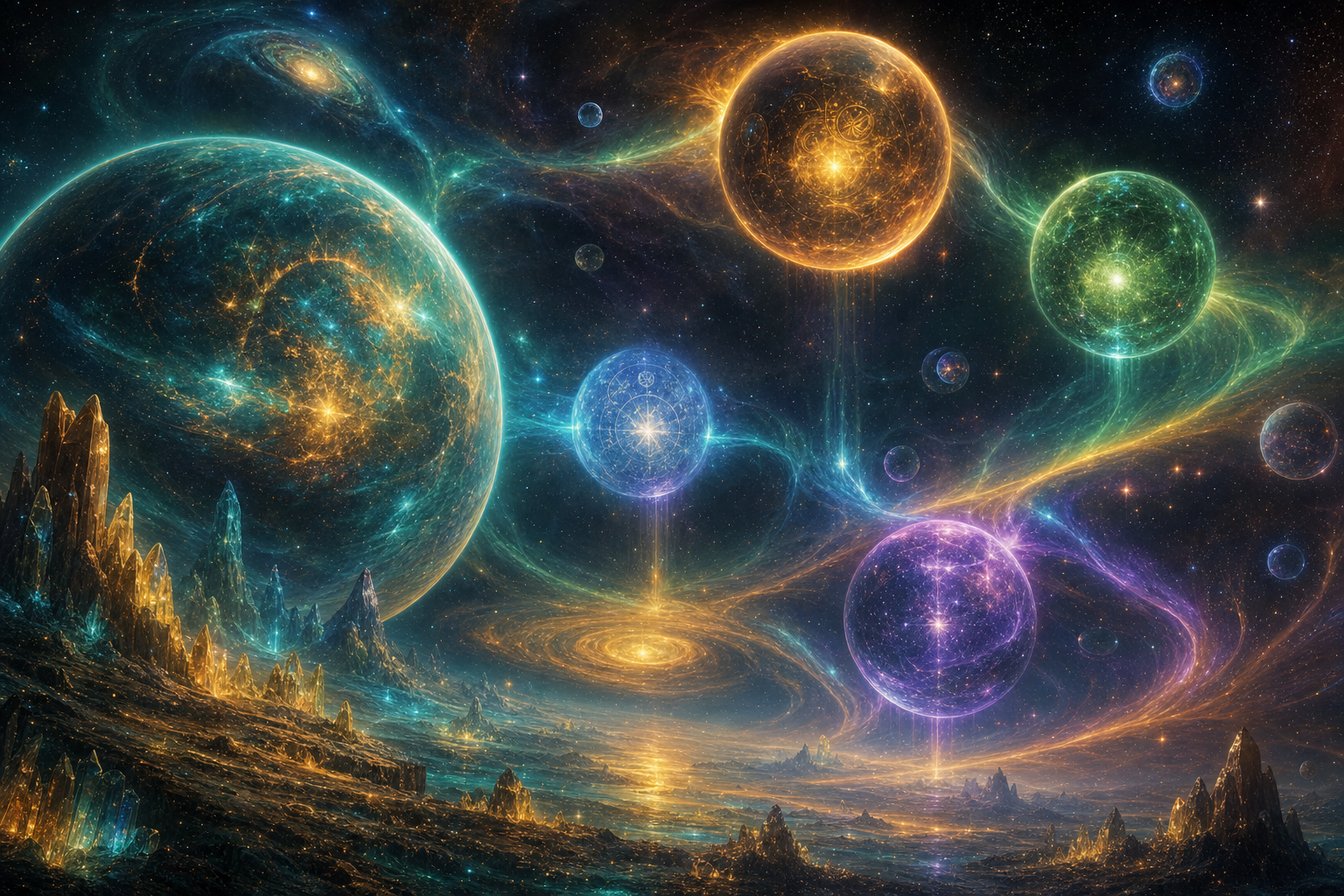
Countless astral planets with suns, moons, and stellar systems. Luminaries resemble the aurora borealis — dazzling and vivid. Eternal spring climate everywhere. No barren wastelands, no dead planets. Beings sustain themselves on cosmic light and luminous vegetables, drinking nectar from fountains of pure light.
An exact counterpart of the last physical form — usually appearing youthful and vital. Made of lifetrons (units of life energy). Not subject to cold, heat, or disease. Can be dematerialized and rematerialized at will. If bruised, healed instantly by willing it. The astral brain is the thousand-petaled lotus; six chakra centers fully awakened.
Governed by intuition rather than five gross senses. Three eyes — two partly closed, the third eye open vertically in the forehead. Sight through ears, hearing through eyes, taste through skin — senses are interchangeable. Communication is pure telepathy and "astral television." No language barriers. No misunderstanding.
No more "that's not what I meant."
Travel on "astral planes of light" — faster than electricity. Objects manifest instantly by will, no chemical processes needed. Offspring are brought into being by cosmic will alone, not by physical birth. Visitors arrive by invitation based on spiritual affinity — you can't just show up uninvited.
Recently deceased humans working out karma. Advanced spiritual beings. Fairies, mermaids, animals, gnomes, demigods, and spirits — the mythological creatures humans sense across every culture are real, just astral. Good spirits travel freely; beings with heavy negative karma are confined to gloom-drenched lower zones.
Average lifespan on higher astral planets: 500 to 1,000 earth years. Time passes differently — more expansive, less urgent. Eventually, beings feel a slight nervousness as their astral karma winds down and transition to the causal world approaches. "Astral death" is the dispersement of lifetrons — the astral body dissolves.
"Physical death is attended by the disappearance of breath and the disintegration of fleshly cells. Astral death consists of the dispersement of lifetrons, those manifest units of energy that constituted the life of the astral form." — Sri Yukteswar
Far fewer souls reach the causal world. It requires complete resolution of astral karma. Here, being and thinking are the same thing — there's no gap between an idea and its existence.
Causal beings exist as individualized souls in a matrix of 35 ideas. There's no need for food or sensory stimulation of any kind. They are sustained by what Sri Yukteswar called "the manna of bliss." Pure joy as the natural state of existence, not as an emotion arising from circumstances.
Thought is creation here. The causal body is the original template — the idea-blueprint from which the astral body was projected, and from which the astral body projected the physical one. Strip away the physical, then the astral, and what remains is this: the essential pattern of an individual soul.
Joyous celebrations occur on the astral planes when a being successfully transitions into the causal world — it's treated as a great graduation.
"Causal beings eat nothing save the 'manna of bliss' — they are sustained by the inner joy of the Infinite." — Sri Yukteswar
The causal body is a matrix of 35 ideas that are the seed of all embodiment:
— 19 of these ideas project as the astral body (mental, emotional, and lifetronic elements)
— 16 of these ideas project as the physical body (the gross material elements)
Shed all 35 ideas and you're free.
Yes — and some choose to. Advanced causal beings sometimes incarnate on high astral planets like Hiranyaloka to help others complete their liberation. Sri Yukteswar himself fits this pattern: he came down from the causal to serve in the astral.
Liberation from the causal world requires shedding the "thought-form of the causal body" — releasing even the most subtle sense of individual existence. What remains after that is pure Consciousness itself. No more rebirth of any kind.
Sri Yukteswar laid out the exact sequence. Not vague promises of heaven — a detailed, karma-dependent process that most souls cycle through many times before finally reaching liberation.
Breath ceases. The physical cells begin to disintegrate. Consciousness — which was never truly located in the body — shifts into the astral form it has carried all along. For most people, this transition is unconscious. For advanced meditators, it is lucid.
The astral destination is determined by karmic qualifications — not arbitrary judgment, but the soul's own vibratory frequency drawn to its matching environment. Most souls go to ordinary astral spheres to work through "seeds of past actions." Evil karma means lower, denser regions. Good karma means greater freedom of movement and higher realms.
Advanced souls who achieved nirbikalpa samadhi on earth may enter Hiranyaloka directly.
Hundreds to thousands of years of astral existence, depending on the density of astral karma to be worked through. The soul grows, learns, and resolves the patterns that couldn't be resolved on earth. Think of it as a very long, vivid, purposeful dream in which real progress is made.
When astral karma is exhausted, two paths diverge:
The astral body dissolves. The soul enters the causal world in its idea-body — the 35-element template of pure thought. Here it works through causal karma: the subtlest patterns of individual existence. Some advanced beings may return to the astral realm in a new astral body to help others before final liberation.
When physical, astral, and causal karma are all exhausted, the causal thought-form dissolves. What was an individual soul recognizes itself as the infinite Consciousness it always was. No more birth. No more death. No more worlds. Just the one Reality that was playing all these games.
This is what Kriya Yoga accelerates. Every practice shortens the journey.
For souls who aren't yet ready for the causal world: Physical ↔ Astral ↔ Physical — repeated as many times as needed. No soul is lost. No soul is abandoned. The direction is always ultimately forward, even when it zigzags. Time in these cycles is vast by human standards; by cosmic standards, it's a brief education.
Not all astral realms are the same. Hiranyaloka is a high astral planet — and the location of Sri Yukteswar's remarkable post-resurrection work.
"Hiranyaloka" translates as "Illumined Astral Planet" — a high-vibration realm within the astral world. Its inhabitants are not typical recently deceased souls. Every being there achieved conscious astral projection at the moment of their physical death. Every being there had progressed beyond sabikalpa samadhi into nirbikalpa samadhi — the highest state of meditative realization.
These are extraordinarily advanced souls. Even they still have astral karma to resolve before they can enter the causal world and proceed toward final liberation. That is precisely what Sri Yukteswar is there to help with.
"My son, you may now comprehend more fully that I am resurrected by divine decree, as a savior of astrally reincarnating souls coming back from the causal sphere, in particular, rather than of those astral beings who are coming up from the earth." — Sri Yukteswar
His primary work is with advanced souls returning from the causal sphere — beings who have completed a causal cycle and returned to Hiranyaloka in new astral bodies to work out remaining astral karma. His mission is not beginner instruction; it's the final polish before liberation.
Sri Yukteswar is operating in the same tradition as every great teacher who deliberately takes on a role of service rather than seeking their own liberation first. The teacher waits at the door to help others through it. This is the Bodhisattva ideal — universal across traditions.
These are the specific terms Sri Yukteswar used in the Bombay conversation. Understanding them precisely makes the teaching much more coherent.
Manifest units of life energy — the building blocks of the astral body. Like atoms are to physical matter, lifetrons are to astral matter. They're not metaphorical; Sri Yukteswar described them as specific, real units of energy that can be dispersed (astral death) or sustained (astral life).
Yogananda's word for what yogic texts call pranic units.
Cosmic delusion — the force that makes the physical world appear independently real and separate from its source. Sri Yukteswar specifically names the physical universe as "governed by maya." The astral and causal worlds are subtler, but maya still operates until final liberation.
Not "illusion" in the sense of fake — more like a very convincing dream.
The highest meditative state — complete union with Infinite Consciousness, with no separate sense of "I" remaining. This is the entry requirement for Hiranyaloka. Contrast with sabikalpa samadhi, where some ego-awareness remains. Nirbikalpa samadhi is achievable in a living human body through advanced Kriya practice.
The passport for the highest astral destinations.
"Illumined Astral Planet" — the high-vibration astral realm where Sri Yukteswar serves as a spiritual teacher. Not accessible to ordinary souls; entry requires lifetimes of advanced practice. The name suggests light (hiranya = golden, luminous) as its defining quality.
Where Sri Yukteswar resides right now, according to this account.
In this context, karma is specifically the accumulated "seeds of past actions" that determine astral placement and the need for continued rebirth cycles. There are three layers: physical karma, astral karma, and causal karma. All three must be worked through for complete liberation.
Not punishment — more like unresolved software that needs to finish running.
The "idea body" — a matrix of 35 causal ideas that is the most subtle individual expression of a soul. It serves as the template from which the astral and physical bodies are projected. When a soul reaches the causal world, only this body remains. Liberation means dissolving even this.
The final thing you are before you become everything.
Sri Yukteswar's cosmology wasn't created in a vacuum. Once you understand Chapter 43, you start hearing echoes of it everywhere — in Christianity, Buddhism, and ancient mythology.
The resurrection motif is unmistakable — Sri Yukteswar returning in a tangible, touchable body three months after death mirrors the post-resurrection appearances of Jesus in the Gospels precisely.
"In my Father's house are many mansions" (John 14:2) maps naturally onto the hundreds of astral planets with their vastly different vibratory levels.
Yogananda noted that God takes whatever form the devotee's heart calls for — appearing as Father, Mother, Son, or Friend depending on the soul's temperament. This is the same God, different face.
The Tibetan Book of the Dead describes bardo states — intermediate realms between physical death and rebirth where consciousness navigates karmic impressions and is placed according to its nature. The structural parallel to the astral world is striking.
The Bodhisattva ideal — remaining available to help beings rather than rushing to final liberation — perfectly mirrors Sri Yukteswar's chosen role on Hiranyaloka.
Buddhist "deva worlds" and "pure lands" also map naturally to high astral planets.
The Sharira Traya — the three-bodies doctrine from classical Vedanta (sthula/gross, sukshma/subtle, karana/causal) — is exactly the framework Sri Yukteswar describes. This isn't new teaching; it's ancient cosmology confirmed by direct experience.
The Lokas of traditional Hindu cosmology (Bhuloka, Bhuvarloka, Svargaloka and beyond) match the physical, astral, and causal worlds directly.
Sabikalpa → Nirbikalpa samadhi as the gateway to higher lokas is standard yogic teaching made vivid and urgent by Sri Yukteswar's account.
What makes Chapter 43 stand out in yogic literature is its specificity. Yogananda uses modern metaphors — television, electricity, the aurora borealis — to make ancient cosmology vivid and accessible.
The concept of "lifetrons" takes classical prana teaching into explicit units. The emphasis on will as the creative force in the astral realms (vs. chemical processes on earth) frames the teaching in terms a scientific mind can engage with.
He was writing for the 20th century. It still holds up.
It's one thing to find this cosmology intellectually fascinating. It's another to let it actually change how you live and practice. Here's what Sri Yukteswar's account implies for daily life.
If astral placement after death is determined by your karmic and spiritual development, then practice isn't a hobby or stress relief. It's preparation. The state you cultivate in meditation is the state you'll navigate with after death. Nirbikalpa samadhi isn't just the pinnacle of practice — it's the entry ticket to Hiranyaloka.
Not to create anxiety — to create motivation.
Sri Yukteswar describes karma as actual "seeds" that determine specific placement in specific realms. This isn't poetic language. It means every action — every thought, word, and deed — is building the conditions of your next existence. Ethical living isn't moralism; it's practical self-interest across the longest timeline.
What you grow in this life, you harvest in the next.
If this cosmology is accurate, death is not an ending — it's a transition to a larger, more vivid, more free existence. The astral world is not a pale shadow of this one; it's a 500-1,000 year adventure in a realm hundreds of times more expansive than the physical universe. Fear of death can transform into something more like curious readiness.
"Death is safe," as Yogananda would say.
The cycling through worlds isn't punishment or failure — it's a curriculum. The difficulty of human life, with its disease and conflict and suffering, is precisely what makes the learning possible here that can't happen in the astral world's easier conditions. Hard courses teach faster. Choosing a human birth is, in a sense, choosing the accelerated track.
Kriya Yoga is the fastest accelerant known to this tradition.
Sri Yukteswar's return makes explicit what devotees across traditions have always felt: the connection between student and teacher is not severed by physical death. If the guru can materialize in Bombay three months after burial to continue the teaching, then the invisible guidance available through deep meditation and sincere practice is not wishful thinking.
The lineage extends beyond the visible world.
Yogananda consistently resisted the urge to soften or metaphorize the extraordinary claims in his book. Sri Yukteswar physically touched him. The meeting was real. The information was precise and internally consistent. This doesn't mean you have to believe it — but it does invite treating it as more than a pretty myth. Experiment with it. Meditate on it. See what it opens.
The tradition doesn't ask for blind faith. It asks for direct investigation.
"The thrilling touch of his divine flesh still persists around the inner sides of my arms and in my palms. The soul of Yukteswarji — that vast, all-knowing soul — I will feel to the end of my life in my physical and spiritual self." — Paramahansa Yogananda, on the Bombay meeting
Chapter 43 — "The Resurrection of Sri Yukteswar" — is in Autobiography of a Yogi. Everything on this page comes directly from Yogananda's account of that afternoon in Bombay. Nothing is embellished.
The original text is richer, stranger, and more moving than any summary. If this material resonates, read the whole chapter. Then probably the whole book.
If the afterlife cosmology is real — and Sri Yukteswar's entire teaching in Chapter 43 hinges on that premise — then Kriya Yoga is not just stress management. It's the fastest known method for working through the karma that would otherwise require thousands of years across multiple lifetimes to resolve.
No notes yet.
Jot down thoughts as you explore.