← BotBuhdy.com Personal Learning Platform
🛕

Hinduism Foundations

Before the book makes sense, you need the map. Brahman, Atman, Maya, Karma — the concepts Yogananda builds everything on.

The Bedrock

Core Concepts

Four ideas that appear on nearly every page of Autobiography of a Yogi. Understanding these unlocks everything else.

Brahman

The ultimate reality — infinite, eternal, formless consciousness that underlies all existence. Not a personal god with preferences, but the ground of being itself. The universe is Brahman appearing as multiplicity.

Think of it as: the ocean that all waves are made of.

Atman

Your individual soul or Self — the witness behind all your thoughts and experiences. The Upanishads make the radical claim: Atman is identical with Brahman. You are not a small self looking for God. You are the ultimate reality, apparently dreaming you're limited.

"Tat Tvam Asi" — "Thou art That"

🎭

Maya

The cosmic veil of illusion that makes the One appear as many. Maya doesn't mean the world is fake — it means we mistake the appearance for the underlying reality. Like mistaking a movie for actual events.

Yogananda called it the "cosmic magician."

⚖️

Karma

The law of cause and effect, operating across lifetimes. Every action — physical, mental, and verbal — creates consequences. This isn't punishment; it's physics. Good news: Yogananda taught that Kriya Yoga literally burns karma.

What you sow, you reap — eventually.

🔄

Samsara & Moksha

Samsara is the cycle of birth, death, and rebirth driven by unresolved karma and desire. Moksha is liberation — the soul's permanent recognition of its unity with Brahman. This is the whole goal. Kriya Yoga is an accelerated method to get there.

Liberation, not heaven.

🕯️

Dharma

Righteous duty and cosmic order. Living in alignment with one's dharma generates positive karma. It's both a personal concept (your specific role and responsibilities) and a universal one (the principles that sustain creation).

Do what's right, in your station, without attachment to results.

The Library

Sacred Texts

Yogananda references these throughout Autobiography of a Yogi. Here's what each one actually is.

📜 The Vedas

c. 1500–500 BCE

The oldest Hindu scriptures — hymns, rituals, and philosophical speculation. Four books: Rig Veda, Sama Veda, Yajur Veda, Atharva Veda. The Rig Veda is among the oldest religious texts in the world. The Vedas are the foundation; everything else is commentary.

🔍 The Upanishads

c. 800–200 BCE

The philosophical "end of the Vedas" (Vedanta). Over 100 texts structured as dialogues between teachers and students exploring the nature of Brahman, Atman, and consciousness. These are where "Thou art That" comes from. Yogananda's teachings are deeply Upanishadic.

⚔️ The Bhagavad Gita

Part of the Mahabharata

Krishna's teaching to Arjuna on the battlefield — on duty, devotion, knowledge, and yoga. 700 verses of stunning philosophy. Yogananda wrote a two-volume commentary interpreting every verse through the lens of Kriya Yoga. Widely considered the heart of Hindu philosophy.

🧘 The Yoga Sutras

Patanjali · c. 400 CE

196 short aphorisms (sutras) that define the complete system of Raja Yoga — the eight limbs, the nature of mind, and the stages of samadhi. The technical manual for what Yogananda practices and teaches. This is where the chakra and pranayama framework comes from.

The Pantheon

Deities and Their Symbolism

A quick clarification: in Hindu philosophy, the deities aren't competing gods. They're facets of the one reality — aspects of Brahman made personable and relatable. Think of them as lenses, not literal beings fighting for supremacy.
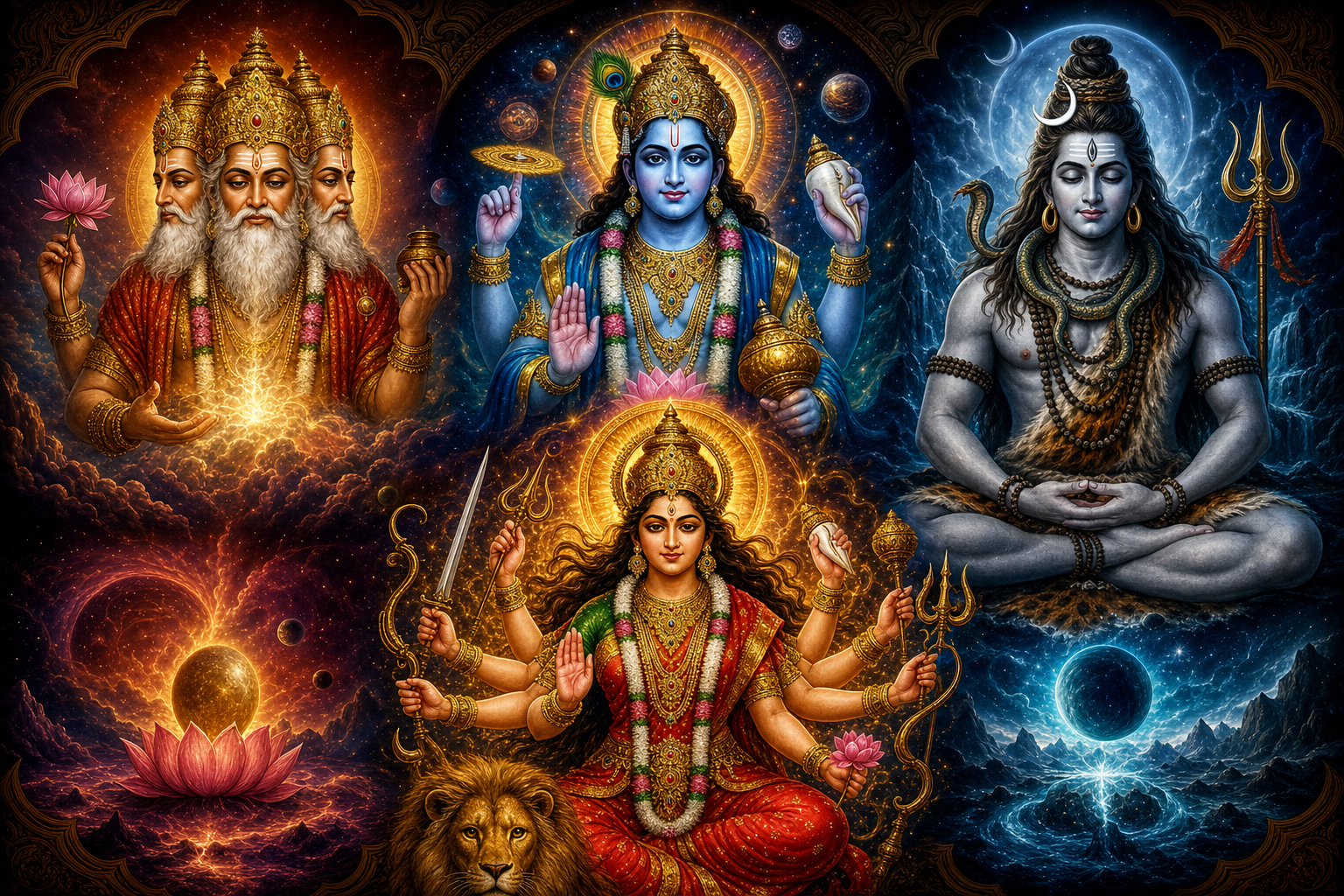
Hindu deities — Brahma, Vishnu, Shiva, Shakti and the divine pantheon
The divine pantheon — facets of the one reality
🌸

Brahma

Creator aspect of the divine trinity (Trimurti). Associated with creation, knowledge, and the Vedas. Less commonly worshipped directly than Vishnu or Shiva.

💙

Vishnu

Preserver of the universe. Appears as avatars (divine incarnations) when the world falls out of balance — including Rama and Krishna. Jesus fits neatly into this framework as a Western avatar, in Yogananda's view.

🌙

Shiva

Destroyer and transformer. Lord of yogis, meditation, and the cosmic dance of creation/destruction (Nataraja). In yogic practice, Shiva represents pure consciousness awaiting union with Shakti (energy).

🔥

Shakti / Devi

The Divine Mother — the active, creative power of the universe. Appears as Durga (warrior), Kali (destroyer of ego), Saraswati (wisdom), Lakshmi (abundance). The universe is literally Her body.

🐘

Ganesha

The elephant-headed son of Shiva and Parvati. Remover of obstacles, lord of new beginnings. Invoked before any important undertaking. One of the most beloved figures in the tradition.

🙌

Hanuman

The devoted monkey-deity from the Ramayana. Represents perfect devotion (bhakti) and selfless service. His love for Rama is used as a model for the devotee's relationship with the Divine.

💡 Yogananda's View on the Deities

He taught that all deities are aspects of the one God — useful as focal points for devotion and concentration. You can approach the Divine through any of them. "God has no religion," he often said. The diversity of forms reflects the diversity of human temperaments, not a diversity of ultimate truths.

Advaita Vedanta

The philosophical school that forms the backbone of Yogananda's teachings. "Advaita" means non-dual — there is only one thing.

Key teacher: Adi Shankaracharya (8th century CE) who systematized the teaching from the Upanishads: Brahman alone is real. The world is apparent. The individual self is identical with Brahman.

The practical implication: you're not a small self trying to reach God. You're God, dreaming you're a small self. Kriya Yoga is the practice of waking up from that dream — not through belief, but through direct experience.

Reincarnation

The soul takes body after body, working through karma until all lessons are learned and liberation is achieved. This isn't punishment — it's the mechanics of consciousness evolving through experience.

Yogananda described advanced souls returning deliberately, like a student choosing harder courses. He claimed to have had past lives as a shepherd in India and as William the Conqueror's cousin — vivid memories that arose in meditation.

"The soul is not a body with a soul, but a soul with a body." — Paramahansa Yogananda
📝 Notepad
📝

No notes yet.
Jot down thoughts as you explore.