The "jet-airplane route" to Self-realization. And that breathing technique - the one that sounds impossible - finally explained.
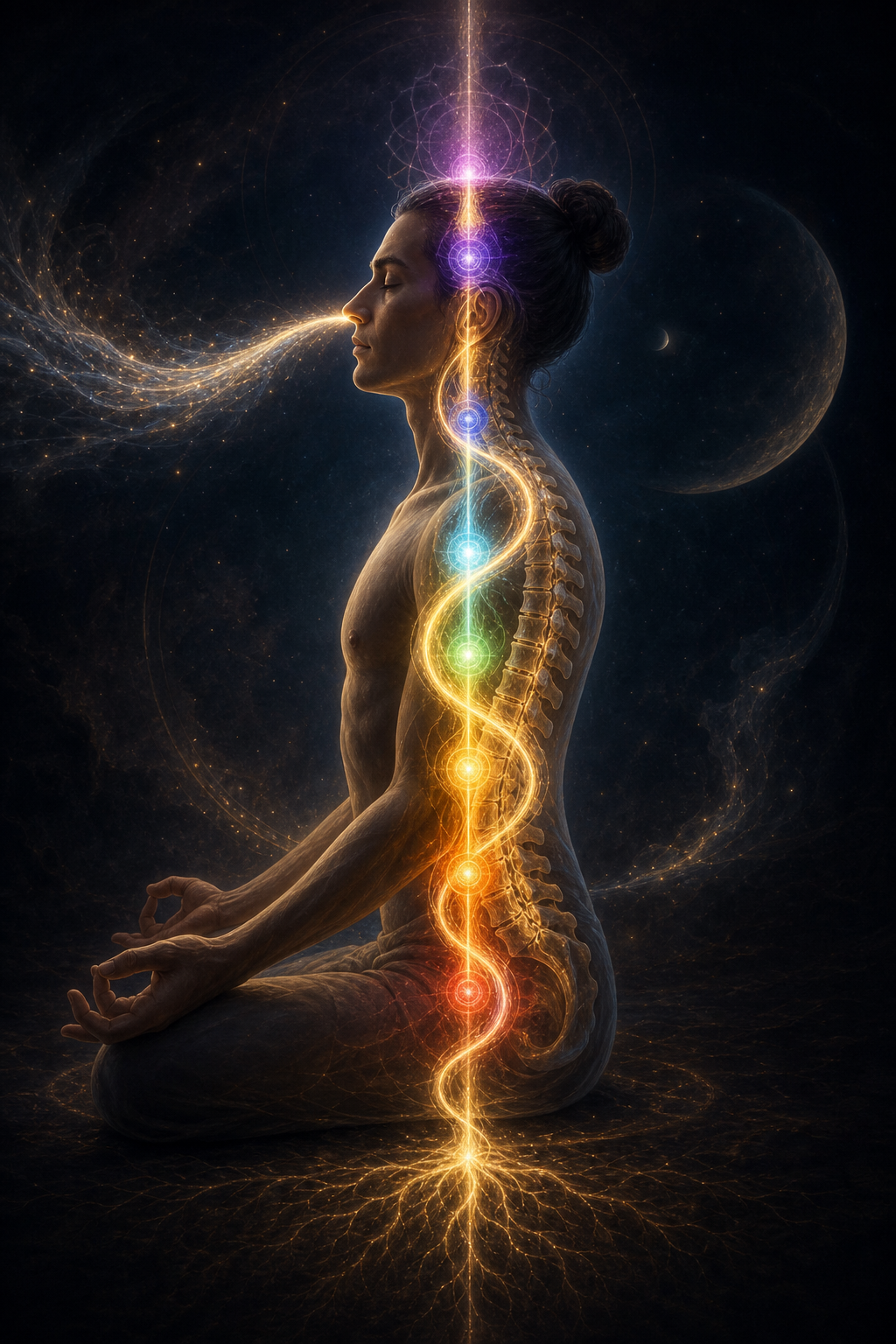
Spinal breathing - prana circulating through the chakra centers
🤔
The Question That Started This
"You breathe in through the nose making a sound - that sounds impossible. How do you make a sound while breathing in?"
Let's answer this clearly before anything else.
The Answer
Ujjayi Breath - Explained
The Key: Your Throat, Not Your Nose
Here's the thing that makes it suddenly click: the sound in Ujjayi (oo-jai-ee) breath is not made in your nose. It's made in the back of your throat.
Your nose is just the channel. The sound source is the glottis - the opening between your vocal cords in your larynx. When you slightly constrict that space while breathing, air passing through creates a soft, oceanic sound in both directions: in AND out.
Think of it as breathing with a very slightly "whispered" quality - like breathing onto a cold window to fog it up, but with your mouth closed and the breath coming through your nose.
🎯 Try This Right Now
Open your mouth and exhale with a soft "haaa" sound - like fogging a window. Feel where that comes from? Back of the throat.
Now inhale the same way with mouth open - you'll hear a soft "haaa" on the inhale too. Same place.
Now do the same thing but close your mouth. The breath routes through your nose, but the sound source stays in the throat.
That's Ujjayi. The nose is the pipe. The throat is the valve making the sound.
What It Sounds Like
🌊 Like Ocean Waves
The most common description. A gentle "shhh" or "ocean" sound - rhythmic, soft, continuous. You can hear it clearly if you listen, but it doesn't disturb anyone nearby.
😴 Like Someone Breathing in Light Sleep
Not snoring - lighter than that. The soft breath sounds you make when deeply relaxed. Ujjayi is the conscious version of what happens naturally in relaxation.
🎙️ Like Whispering While Breathing
Or like the "haaaa" sound someone makes when they see something beautiful - except sustained as a breath, through the nose, both on the inhale and exhale.
🔊 Yogananda's Description
He called it a "motor-like sound" - smooth, consistent, mechanical. Not breathy and irregular, but controlled and rhythmic like an engine running smoothly.
🧠 Why the Sound Matters - It's Not Decoration
The slight glottis constriction in Ujjayi breath does several things simultaneously:
Slows the breath - the resistance forces you to breathe more slowly and deeply than normal.
Creates an anchor - the continuous audible sound gives your mind something to track, preventing it from wandering.
Stimulates the vagus nerve - research shows this specific throat engagement activates the parasympathetic nervous system, creating deep calm.
Builds internal pressure - slight positive pressure aids prana distribution through the subtle channels (nadis).
In yogic physiology, the glottis activation is also said to:
Stimulate the Vishuddha (throat) chakra.
Create a continuous subtle vibration in the spinal column.
Help maintain the meditative state by keeping the practitioner on the edge of alertness - not drowsy, not hyperactive.
Allow the practitioner to precisely track how many kriyas (breath cycles) have been completed without breaking concentration.
💡 Once you understand that the throat (not the nose) makes the sound, the technique goes from "impossible" to "obvious." It's the same mechanism as whispering.
The Foundation
What Kriya Yoga Is
Kriya means "action" or "deed." In this context, it refers to a specific action: consciously directing life force (prana) up and down the spine, magnetizing the spinal centers (chakras) and progressively withdrawing consciousness from body-identification into soul-awareness.
Yogananda called it the "jet-airplane route" to God-realization - claiming that sincere practice can achieve in one year what ordinary spiritual effort takes many lifetimes to accomplish.
His claim was bold: one Kriya (one complete breath cycle) equals approximately one year of natural spiritual evolution. He invited skeptics to test this themselves rather than argue about it.
"Kriya Yoga is the scientific technique that leads to the realization of God. It is the highway to Self-realization."
- Paramahansa Yogananda
What Makes Kriya Different
Most meditation practices:
Observe the breath passively. Watch thoughts arise and pass. Repeat a mantra. These are excellent - and slow. Consciousness is being gradually redirected inward.
Kriya Yoga:
Actively manipulates prana. Instead of watching the breath, the yogi is consciously steering life force through the spinal column. It works directly on the subtle anatomy - the energy channels and chakras - rather than just on the mind.
This is why Yogananda compared ordinary meditation to walking and Kriya to flying. Same destination; very different vehicles.
Step by Step
The Kriya Practice (General Framework)
The complete technique requires formal initiation. What follows is the publicly described framework — enough to understand what's happening and why. The living transmission adds what words cannot convey.
Padmasana — the supreme meditation seat for Kriya practice
1
Preparation — Energization Exercises
Yogananda's 39 energization exercises are done first. They consciously direct prana into every part of the body using tension and relaxation. The purpose: remove physical tension, teach conscious prana control, create the calm-yet-alert state needed for deep meditation. Takes 12–15 minutes.
▶ The 39 Energization Exercises — Complete Tutorial
🙏 Core Principle
"The greater the will, the greater the flow of energy." — Paramahansa Yogananda
Energy (prana) enters through the medulla oblongata — the point where the skull meets the spine at the back of the head, called "the mouth of God" in scripture. Your willpower is the switch that draws cosmic energy in and directs it to specific body parts.
How to tense: Tense gradually — low → medium → high. Then relax gradually — high → medium → low → complete release. Focus at the center of the muscle being tensed. Feel the energy, not just the physical tension.
🌬️ The Double Breath
Many exercises begin or end with Yogananda's special double breath: Inhale: short sharp sniff through the nose, immediately followed by a long strong inhalation — filling the lungs completely. Exhale: short sharp puff through mouth and nose, immediately followed by a long strong exhalation — emptying completely.
This oxygenates the blood and clears toxins. It sounds like: huh-huuuuuh… hah-haaaaah…
📋 The 39 Exercises by Body Region
Always begin with a prayer. All movements should be smooth and flowing. Only three exercises involve jerking motions (head drop and torso rotations). Pay close attention to hand and palm positions — they affect energy flow.
Opening (Exercises 1–3)
Opening Prayer & Double Breath — Stand straight, palms together at chest. Take a double breath. Set your intention to draw cosmic energy.
Full Body Tense & Relax — Inhale, tense the entire body (low → medium → high), exhale and release completely. Feel energy washing through every cell.
Double Breath with Arms — Arms at sides. Double breath while raising arms overhead, tensing progressively. Exhale and release, arms back down.
Feet & Legs (Exercises 4–9)
Left Foot — Tense left foot only (low-medium-high), relax, feel the energy.
Right Foot — Same, right foot.
Left Calf — Isolate and tense the left calf muscle.
Right Calf — Same, right calf.
Left Thigh — Tense the left thigh (quadricep and hamstring).
Right Thigh — Same, right thigh.
Hips, Buttocks & Abdomen (Exercises 10–14)
Left Buttock — Tense the left gluteal muscle independently.
Right Buttock — Same, right side.
Abdomen (Lower) — Tense the lower abdominal muscles with will.
Abdomen (Upper / Navel) — Tense the area around and above the navel.
Diaphragm & Solar Plexus — Focus energy at the solar plexus center (Manipura).
Hands & Arms (Exercises 15–22)
Left Hand (Fist Clench) — Clench left fist, tense progressively, release.
Right Hand (Fist Clench) — Same, right hand.
Left Forearm — Tense left forearm muscles.
Right Forearm — Same, right forearm.
Left Upper Arm (Bicep) — Tense the left bicep with focused will.
Right Upper Arm (Bicep) — Same, right side.
Left Upper Arm (Tricep) — Tense the back of the left arm.
Right Upper Arm (Tricep) — Same, right side.
Chest, Back & Shoulders (Exercises 23–28)
Left Chest (Pectoral) — Tense the left chest muscle.
Right Chest (Pectoral) — Same, right side.
Left Shoulder — Raise and tense the left shoulder (deltoid).
Right Shoulder — Same, right side.
Upper Back (between shoulder blades) — Squeeze shoulder blades together, tense the rhomboids.
Lower Back — Tense the lumbar region with focused will.
Neck & Head (Exercises 29–33)
Left Neck — Tense the left side of the neck.
Right Neck — Same, right side.
Back of Neck / Medulla — Tense the area around the medulla oblongata, the seat of incoming cosmic energy.
Throat — Gently tense the front throat muscles (Vishuddha region).
Face & Jaw — Tense all facial muscles, then release completely.
Whole Body Integration & Closing (Exercises 34–39)
Whole Body Tense (Standing) — Full body tension from toes to head, with double breath.
Torso Rotation (Left) — Rotate the upper body left with a gentle jerking motion, releasing tension.
Torso Rotation (Right) — Same, rotating right.
Head Drop Forward — Let the head drop gently forward, releasing neck tension (one of the three "jerking" exercises).
Full Body Vibration — Vibrate/shake the entire body rapidly, then come to complete stillness. Feel the contrast.
Closing Double Breath & Prayer — Final double breath drawing energy to the spiritual eye. Stand in stillness and feel the body recharged with prana.
📝 Practice Notes:
• Start with the slow-pace guided video from Ananda until the sequence becomes natural
• 12–15 minutes once you know the routine; beginners may take 20+ minutes
• Practice twice daily — before morning and evening meditation
• "The whole purpose of true exercise is to awaken the inner source of energy which we have ignored throughout our lives." — Yogananda
• These exercises are traditionally learned through SRF Lessons or Ananda's meditation course for the most detailed and precise instruction
2
Hong-Sau Technique — Stilling the Mind
Concentration on the natural breath, mentally tracking the sounds "Hong" (inhale) and "Sau" (exhale) — Sanskrit words meaning "I am He" or "I am Spirit." No manipulation of breath, just watching. This calms the mental chatter and prepares the mind for deeper practice. Usually 15–30 minutes.
▶ Hong-Sau — Complete Practice Guide
🕉️ What is Hong-Sau?
"Hong-Sau" (also written Ham-Sa) is a Sanskrit mantra meaning "I am He" or "I am Spirit." Yogananda taught that Hong-Sau is the natural vibration of the breath itself — with every inhalation the subtle sound "Hong" occurs, with every exhalation "Sau" occurs. You've been breathing this mantra your entire life. The technique simply makes it conscious.
Hong-Sau is one of the four pillars of Yogananda's path, alongside Energization, the Aum technique, and Kriya Yoga proper. It develops the deep concentration needed for all higher practices.
🪷 Step-by-Step Practice
1. Posture
Sit upright with a straight spine — on a chair (sit forward, don't lean back) or cross-legged on the floor. Feet flat if in a chair. Hands resting palms-up on your thighs at the junction of thigh and abdomen. Spine straight but not rigid — think of a garden hose: if it's kinked, the water (prana) can't flow.
2. Prepare
Close your eyes. Lift your gaze gently — behind closed eyelids — toward the point between your eyebrows. This is the spiritual eye (kutastha), also called the "Christ center." Don't strain or cross your eyes. Just incline your attention upward and forward, as if gazing at a distant horizon from a hilltop.
Take 3–4 deep breaths: inhale slowly counting to 8, hold for 8, exhale for 8. With each breath, tense the whole body on the inhale and release all tension on the exhale.
3. The Technique
Let your breath return to its completely natural rhythm. Do not control it. Do not try to breathe deeply or slowly. Your only job is to watch.
• As breath flows in naturally → mentally say "Hong" (rhymes with "song")
• As breath flows out naturally → mentally say "Sau" (rhymes with "saw")
The breath leads. The mantra follows. Don't force them to synchronize — let the word gently ride the breath like a leaf on water.
4. Focus Point
Keep your attention at the spiritual eye (point between the eyebrows) throughout the practice. Initially you may also feel the breath at the point where it enters the nostrils. As you become calmer, feel the breath higher and higher in the nose. Do not let your eyes follow the movement of the breath.
5. The Sacred Pauses
If the breath naturally pauses — after inhalation or after exhalation — do not force it to resume. Rest in that pause. Enjoy it. These natural pauses between breaths are, according to Yogananda, the doorways to deeper states of consciousness. The longer and more comfortable these pauses become, the deeper your meditation is going.
6. When the Mind Wanders
Your mind will wander — a hundred times in a single session if you're new. This is completely normal. Simply bring your attention back to the breath and the mantra. Hong… Sau… Hong… Sau…
"The restless mind resists all attempts to concentrate, and plays tricks to draw your attention away. Never give up. Never accept defeat." — Yogananda
Every time you bring attention back, you strengthen the muscle of concentration. The wandering isn't failure. Not noticing that you've wandered — and staying lost — is the only thing that even resembles failure.
7. Closing
After your practice period, stop the mantra but don't open your eyes. Sit in whatever stillness is present for another minute or two. Just be with what's there. Then slowly return to outward awareness.
⏱️ Duration & Frequency
5–10 min
Beginner — just start
15–30 min
Regular practice
30–60+ min
Deep practice
Yogananda recommended meditating twice daily — morning and evening. Consistency matters far more than duration. Ten minutes every day beats an hour once a week. "The purpose of meditation is to quiet the mind so that the light of the soul can shine through. It is not a matter of how many hours you sit but how deeply you go."
⚠️ Common Mistakes
Controlling the breath — The #1 mistake. You're watching, not driving. Let the breath be shallow, deep, fast, slow — whatever it wants.
Straining the eyes — The upward gaze should be gentle, like looking at a sunset. If your eyes twitch or ache, relax them briefly.
Self-judgment — Thinking "I'm terrible at this" is just another thought. Notice it. Return to Hong-Sau.
Expecting fireworks — Most sessions feel quiet and ordinary. That's fine. The changes happen beneath the surface.
Stopping when it's working — If you feel calm and still, don't immediately open your eyes. That stillness is the meditation. Stay in it.
🌟 What Happens Over Time:
In the first weeks, your mind may feel noisier — it hasn't gotten worse, you're just noticing the noise for the first time. Gradually, gaps appear between thoughts. The breath starts to slow, sometimes dramatically. Advanced practitioners experience moments where the breath seems to stop entirely — not suffocation, but a state where life force sustains itself directly. Yogananda called this the doorway to superconsciousness.
3
Aum Technique — Tuning to Inner Sound
Listening for the cosmic sound (Aum/Om) in the right ear. This is the "sound of creation" — described as a deep humming, roaring, or music-like sound that becomes audible in deep meditation when the external senses withdraw. Connects the practitioner to the vibration underlying all of creation.
▶ The Aum Technique — Complete Practice Guide
🕉️ What is Aum?
Aum (Om) is the primordial sound vibration from which all creation emerged — called Pranava, "that which pervades all life." In Christianity, it is the Holy Ghost or "Word" ("In the beginning was the Word" — John 1:1). It is the intelligent cosmic energy that issues forth from God and is the link between matter and Spirit.
"Patanjali says that attainment of the highest samadhi is possible 'by profound, devoted meditation on Ishvara… His symbol is Aum.'" — Yogananda
🎵 The Inner Astral Sounds
As the Aum vibration works through the spinal chakra centers, each center produces a characteristic sound. The advancing meditator hears these progressively:
🐝
Humming of a bee
Muladhara
🪈
Tone of a flute
Svadhisthana
🎵
Stringed harp
Manipura
🔔
Bell or gong
Anahata
🌊
Roar of the sea
Vishuddha
🎶
Cosmic symphony
Ajna
🪷 Three Stages of Practice
Stage 1 — Chanting Aum Aloud
Begin by chanting "Aum" out loud repeatedly. Feel the vibration in your chest, throat, and head. The "A" resonates in the abdomen, the "U" in the chest, and the "M" in the head/crown. This creates a sense of sacredness and attunes the body to the vibration.
Stage 2 — Whispering Aum
Reduce the chanting to a whisper. The vibration becomes more subtle, drawing your awareness inward. Feel the mantra more than you hear it.
Stage 3 — Mental Chanting & Listening
Chant Aum silently in the mind. Then stop chanting and simply listen. In deep stillness, the cosmic Aum sound becomes audible internally — first as a faint hum or ringing, then growing into a deep, oceanic vibration. Focus your attention in the right ear, or at the point between the eyebrows. Don't strain to hear it — open your awareness and let it come to you.
🌟 The Spiritual Eye
In deepest Aum meditation, advanced practitioners perceive the spiritual eye — a luminous ring of golden light surrounding a field of deep blue, with a silvery-white star at the center. This represents the three stages of divine ascent:
Gold ring — Cosmic Energy (Aum / Holy Ghost) Blue field — Christ Consciousness (Kutastha / TAT) White star — Cosmic Consciousness (Spirit / SAT)
"By inwardly following the sound of Pranava to its source, the yogi's consciousness is carried aloft to God." — Yogananda
📝 Note: The full Aum technique is traditionally received through initiation — either through SRF Lessons or an authorized Kriya Yoga teacher. What is described here are the foundational principles. The formal technique includes specific hand positions (mudras) and precise instructions for closing the ears and directing attention to the inner sounds.
4
Kriya Proper — Spinal Breathing
The central technique. Using Ujjayi breath (the throat sound explained above), the practitioner visualizes and feels prana moving up the spine from the coccyx to the brain on the inhalation, briefly focusing at each chakra, then down the spine on the exhalation. One up-and-down circuit = one Kriya. Beginners do 12–24 rounds; advanced practitioners may do 144 or more.
▶ Kriya Pranayama — The Spinal Breathing Practice
⚡ What is Kriya Pranayama?
Kriya Pranayama is the core technique of Kriya Yoga — a precise method of circulating life force (prana) up and down the spine through the six chakra centers. Yogananda described it as an "airplane route to God" — each Kriya circuit is equivalent to one year of natural spiritual evolution. Twelve rounds = twelve years of growth in minutes.
"Kriya Yoga is the real 'fire rite' — not the outward Vedic fire ceremony, but the inner practice of directing the currents of prana and apana up and down the spine, magnetizing it and awakening the dormant spiritual centers." — Yogananda
🔥 Ujjayi Breath — The Foundation
Kriya uses Ujjayi breathing — a gentle throat constriction that creates a soft, ocean-like sound during both inhalation and exhalation. The breath flows through the nose, but the subtle friction in the throat creates an audible whisper:
• Imagine fogging a mirror with your mouth open — that's the throat position
• Now close your mouth and breathe through the nose, keeping that constriction
• The sound should be smooth and continuous, like distant ocean waves
• This sound becomes the vehicle that carries your awareness along the spine
🧬 The Spinal Pathway — Six Chakras
During each Kriya, awareness ascends through these six centers in the "hollow tube" of the astral spine (sushumna):
🔴
1. Muladhara— Coccyx (base of spine). Earth element. Starting point of ascending prana.
🟠
2. Svadhisthana— Sacral region. Water element. Seat of creative energy.
🟡
3. Manipura— Lumbar / navel. Fire element. Center of willpower and vitality.
🟢
4. Anahata— Heart / dorsal. Air element. Center of love and compassion.
🔵
5. Vishuddha— Throat / cervical. Ether element. Center of calm expression.
🟣
6. Ajna— Medulla / spiritual eye. Seat of superconscious perception. The "third eye."
🔄 One Kriya Circuit
Ascending (Inhalation)
With Ujjayi breath, inhale slowly. Visualize and feel prana rising from the base of the spine (Muladhara) upward through each chakra — sacral, navel, heart, throat — arriving at the medulla/spiritual eye (Ajna). Briefly pause at each center, feeling the energy activate it like a small light illuminating.
Descending (Exhalation)
Exhale with the same Ujjayi sound. Feel the energy descending from the spiritual eye back down through each chakra to the base. The spine becomes magnetized — the "altar of God" within your own body.
That's One Kriya
One complete up-and-down circuit = one Kriya. The breath should be slow, smooth, and conscious. Each round deepens the magnetization of the spine and withdraws life force from the outer senses into the spinal highway.
📊 How Many Rounds?
12–24
Beginner (standard practice)
24–72
Intermediate (with practice)
144+
Advanced (deep practice)
⚠️ Important: Kriya Pranayama is traditionally transmitted through formal initiation from a guru or authorized teacher. What is described here is a general understanding of the practice. SRF requires students to practice Hong-Sau, Aum technique, and Energization exercises for six months to a year before receiving Kriya initiation. This isn't gatekeeping — it's preparation. The ground needs to be ready for the seed.
5
Resting in the Aftereffects
After the Kriyas, the practitioner sits in stillness and allows the practice to settle. This is often where the deepest experiences occur — the mind has been thoroughly quieted, and pure awareness may shine through. Sometimes this is the most important part.
▶ The Practice of Stillness — The Most Vital Part
🤫 Why Stillness is Everything
"Stillness is God." — Paramahansa Yogananda
The techniques (Energization, Hong-Sau, Aum, Kriya) are not the meditation itself — they are preparation for meditation. True meditation begins when the techniques end and you simply rest in the stillness they have created. This resting phase is where communion with the Divine actually happens.
"Be still, and know that I am God." — Psalm 46:10
Brother Anandamoy of SRF described it: "In stillness there is conscious awareness — a deeply alert state without thoughts." It is not sleep, not blankness, not spacing out. It is the most awake you have ever been — but awake to what is within rather than without.
🪷 How to Practice
1. Stop All Techniques
After completing your Kriyas (or Hong-Sau, or Aum practice), gently release the technique. Stop the mantra, stop counting breaths, stop visualizing. Let everything go.
2. Keep Your Gaze at the Spiritual Eye
Maintain gentle focus at the point between the eyebrows. Don't strain. Your awareness rests here like a bird landing on a branch — light and alert, not gripping.
3. Simply Be
Don't try to do anything. Don't try to feel anything specific. Don't try to have an experience. Just sit in whatever quality of stillness is present. If peace comes, rest in it. If joy comes, let it bloom. If nothing comes, that's also perfect — you are training the mind to be still without needing entertainment.
4. If the Stillness Deepens — Stay
If you feel a profound calm, a sense of expansion, a sweetness, or the presence of light — do not move on. This is what the entire practice is for. Recognize it. Appreciate it. Remain in it as long as it lasts. Never rush past stillness to get to the next item on your agenda.
5. Duration
Practice 2–5 minutes of stillness after each technique (Hong-Sau, Aum, Kriya). After the final technique, sit in stillness for as long as you feel drawn to — 5 minutes, 15 minutes, or longer. Yogananda himself sometimes sat for hours after his Kriyas. "It is not difficult for me to sit for meditation, but it is difficult for me to get up from meditation."
💡 The Paradox: Many meditators rush through their techniques to "get to the good part" but then immediately open their eyes when the stillness comes. This is like running a marathon to reach a beautiful garden and then walking straight through it without looking. The stillness is the garden. The techniques are just the road that gets you there. Spend at least as much time in stillness as you spend on techniques.
6
Closing — Devotion and Gratitude
Prayer, chanting, or simple gratitude. Sealing the practice with devotion and consciously offering the fruits to something larger than personal gain. Yogananda considered this essential — technique without devotion was mechanical; devotion without technique was emotional but scattered.
▶ Closing Your Practice — Devotion & Integration
🙏 Why Devotion Matters
Yogananda was emphatic: the yoga path has two wings — technique and devotion. One without the other cannot fly. Technique without devotion becomes mechanical exercise, producing calm but not transformation. Devotion without technique becomes emotional worship, sincere but scattered and unable to penetrate the deeper layers of consciousness.
"True prayer is an expression of the soul, an urge from the soul. It is a hunger for God that arises from within, expressing itself to Him ardently, silently." — Yogananda
🪷 How to Close Your Practice
1. Prayer from the Heart
Speak to God, the Divine, the Infinite — whatever name feels true to you — in your own words. Not a formula. A conversation. Share gratitude for the meditation, ask for guidance, offer your practice for the benefit of others. Yogananda's tradition included specific prayers, but the essence is sincerity, not script.
2. Healing Prayers
Yogananda encouraged sending healing vibrations at the close of meditation — to yourself, to loved ones, to the world. In the state of deep calm after practice, your prayers carry a charge they don't have during ordinary waking consciousness. Visualize divine light flowing from your spiritual eye to those who need healing.
3. Chanting (Optional)
A devotional chant can seal the practice with vibration and feeling. Yogananda's tradition includes many chants — "O God Beautiful", "Listen, Listen, Listen", "In the Temple of Silence" — but any sincere devotional song works. The purpose: let the heart express what the mind cannot.
4. Offering the Fruits
Consciously offer the peace, energy, and clarity you've gathered to something larger than yourself. This transforms meditation from self-improvement into service. "I offer this practice to the Divine. May the peace I have found flow through me to all I encounter today."
5. Transition Mindfully
Don't jump up and check your phone. Sit for a moment with eyes still closed. Feel the quality of consciousness you've cultivated. Then slowly open your eyes. Let the first thing you see be received with the same quality of attention you brought to the spiritual eye. Carry the stillness into your first actions of the day — this is how meditation transforms daily life, not just the minutes on the cushion.
🌅 The Five Stages of Meditation (as taught by Swami Smaranananda):
1. Prayer — Setting intention and invoking grace
2. Chanting or Reading — Attuning the heart
3. Meditation Techniques — Energization, Hong-Sau, Aum, Kriya
4. Practice of Stillness — Resting in the aftereffects
5. Practice of Devotion — Prayer, healing, offering
The complete practice begins and ends with the heart. The techniques in between are the bridge.
⏱️ Time Commitment
A full Kriya session runs 30-90 minutes, sometimes longer. Yogananda taught daily practice as the foundation. "Even 15 minutes of deep practice," he said, "is worth more than hours of scattered effort." Quality of attention matters far more than duration.
The Inner Anatomy
The Spine as Tree of Life
In yogic anatomy, the spine is not merely a physical structure - it is the axis mundi, the "tree of life" of the subtle body. Three primary energy channels (nadis) run through and around it:
Sushumna - The central channel running through the spinal cord. This is the "royal road" - the path Kundalini takes when properly awakened, and the channel Kriya works with directly.
Ida - The lunar channel, running to the left of Sushumna. Associated with cooling, receptive, feminine energy. Connects to the left nostril.
Pingala - The solar channel, running to the right. Associated with heating, active, masculine energy. Connects to the right nostril.
Kriya practice aims to balance Ida and Pingala and redirect energy into Sushumna - the central channel that leads directly to higher consciousness.
What Circulating Prana Actually Does
🧲 Magnetizes the chakras - charging them like batteries, awakening their latent faculties (intuition, compassion, cosmic consciousness).
🔥 Burns karma - Yogananda taught that accumulated karmic patterns are stored in the spinal centers as "seeds." Prana circulation literally dissolves these patterns before they can sprout as life circumstances.
🧬 Rejuvenates the nervous system - measurable physiological effects: reduced heart rate, lower oxygen consumption, slower brainwave activity, and what researchers call a "metabolic holiday" state.
🌅 Withdraws consciousness from the senses - progressively freeing awareness from its default entanglement with sensory experience, until the soul recognizes itself as something that exists independent of the body.
The Sacred Element
Why Initiation Matters
⚡
The Energetic Transmission
Kriya is not just a technique - it includes a direct energetic transmission from the initiated teacher to the student. This "shaktipat" (awakening touch/gaze/intention) is what activates the practice at a level that reading instructions cannot achieve. The guru acts as a living channel.
🛡️
Protection and Guidance
Powerful practices can destabilize unprepared practitioners. The formal initiation channel provides ongoing support, correction, and protection. Yogananda's SRF continues this function - initiated students receive guidance across their lifetimes of practice.
🧩
The Missing Subtleties
Written descriptions (including this page) convey the concepts. But the precise physical details - exactly how to position the eyes, the exact degree of glottis engagement, the precise mental imagery - these require person-to-person transmission. Some things can't survive compression into text.
🌱
Prerequisites
SRF requires students to practice Hong-Sau, Aum technique, and Energization exercises for six months to a year before receiving Kriya initiation. This isn't gatekeeping - it's preparation. The ground needs to be ready for the seed.
The Experience
What Practitioners Report
Common experiences reported by sincere, long-term Kriya practitioners - across cultures and traditions.
☮️
Deep, stable peace that persists beyond the meditation session - a background calmness that doesn't disappear when life gets complicated.
💡
Spontaneous intuitive knowing - insights arising without deliberate reasoning. Decisions becoming clearer. The sense that something wise is operating beneath the chattering mind.
🌟
Experiences of light and sound within the body during meditation - the inner light at the ajna chakra, the inner Om sound (sometimes described as bells, wind, ocean, or music).
⚡
Spontaneous withdrawal from body consciousness - the sense of being awareness itself, temporarily unbounded by physical form. Varying intensities, from subtle expansion to complete transcendence.
🥗
Reduced need for sleep and food - long-term practitioners often report that their need for external energy sources decreases as internal prana supply increases. Yogananda taught this directly.
❤️
Expanded compassion and love - the natural result of ego boundaries softening. Many practitioners report the gradual dissolution of habitual selfishness without effort or moral instruction.
🚪 Want to Actually Learn It?
This page explains the concepts. The actual technique is taught through formal initiation by Yogananda's organization.