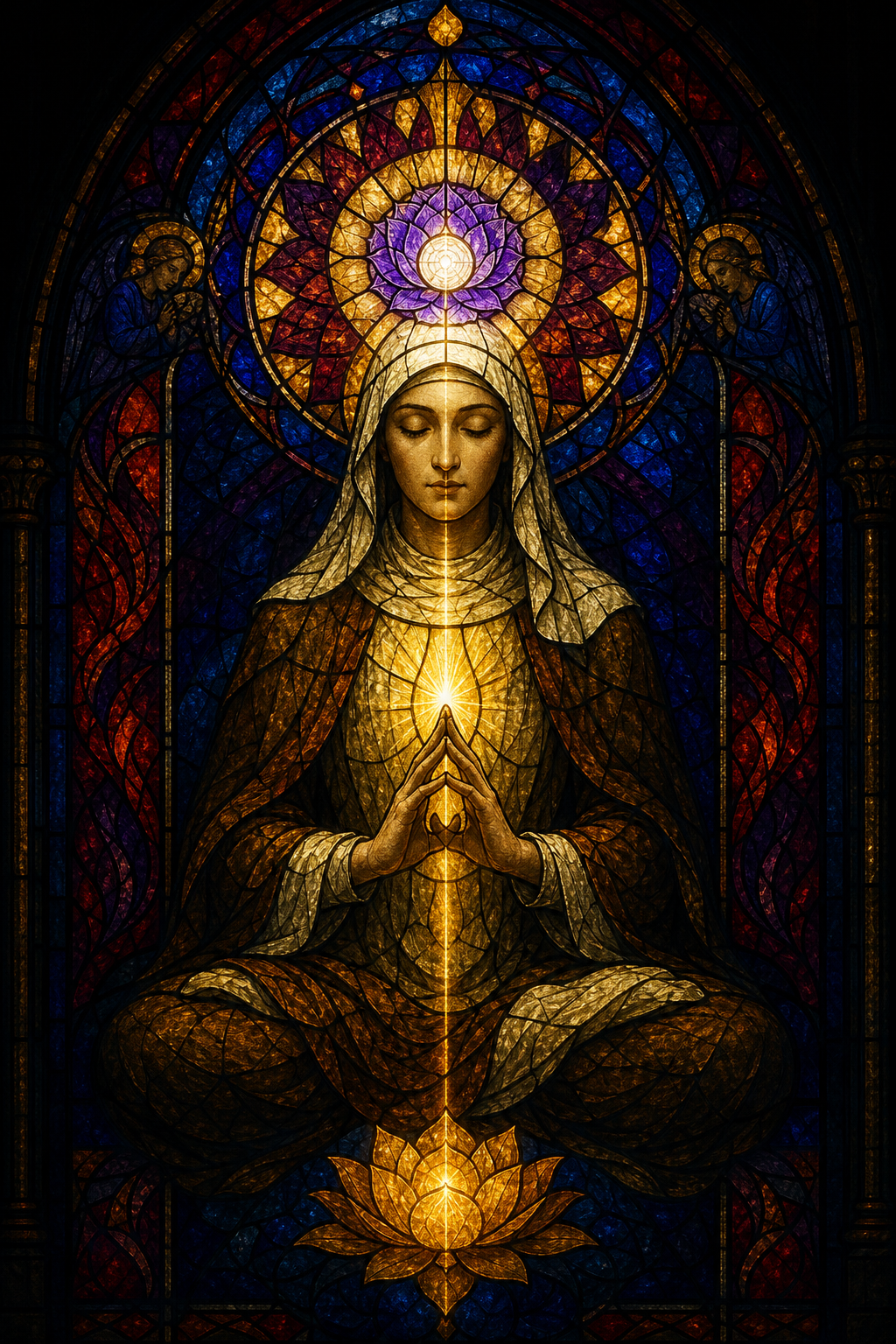
The Great Paradox
The Vatican's 1989 letter warns against Eastern techniques that "put aside everything worldly, sense-perceptible or conceptually limited" and seek the "absolute beyond images and concepts." Yet the Church elevates to sainthood figures who describe precisely this — a total dissolution of ego, a dark night stripping away all consolation, and a final union with the divine that transcends all images and concepts.
The official resolution is that the source and interpretation are different — grace vs. technique, Christ-mediated vs. autonomous. Whether this resolves the paradox or merely restates it is worth sitting with.
Meister Eckhart
Dominican friar, theologian, mystic · c. 1260–1328
"The eye through which I see God is the same eye through which God sees me." — Meister Eckhart
His Teaching
Eckhart taught Gelassenheit — radical detachment — as the path to the "birth of God in the soul." He distinguished between the Godhead (the ground of being beyond all attributes, beyond even the personal God) and God (the personal deity of devotion). In the highest state, the soul returns to the undifferentiated ground from which it emerged.
Yogic Parallels
- Godhead vs. God = Brahman vs. Ishvara (impersonal absolute vs. personal deity)
- Soul's return to "uncreated ground" = Atman realizing its identity with Brahman
- Radical emptiness and detachment = Advaita and Buddhist śūnyatā teachings
- The eye that sees God is the eye of Brahman = nondual awareness
⚖️ The Church's Response
Eckhart was condemned by Pope John XXII in 1329 — posthumously. Several propositions were declared heretical, particularly those implying the soul could become identical with God in a way that erased creaturely distinction. He remains officially condemned, yet is one of the most widely studied Christian mystics in the world. His rehabilitation continues informally.
St. John of the Cross
Carmelite friar, Doctor of the Church · 1542–1591
"In order to arrive at having pleasure in everything, desire to have pleasure in nothing." — The Ascent of Mount Carmel
The Dark Night of the Soul
John described a multi-stage journey of spiritual purification that strips away everything — including the consolations of faith itself:
Active Night of the Senses
Voluntary detachment from sensory pleasures and spiritual consolations. You practice discipline; it's still "your" effort.
Passive Night of the Senses
God withdraws sensory consolations — prayer becomes dry, devotion loses its emotional charge. You can do nothing about it. Aridity is the teacher.
Active Night of the Spirit
The will and intellect are purified — even spiritual understanding is released. The concepts we hold about God are stripped away.
Passive Night of the Spirit
The most extreme purification — even the sense of God's presence disappears. Total desolation. This is the last defense of the ego before annihilation.
Spiritual Marriage
Transforming union with God — the soul is not absorbed or lost, but so thoroughly united with divine will that all action flows from Love.
Yogic Parallel
The Dark Night closely parallels kundalini purification crises — the intense upheaval as life force moves through blocked channels. The dissolution of ego structures before samadhi. The eight limbs of yoga also describe progressive stages ending in the union of Atman with Brahman.
The Church's Take
John was imprisoned by his own Carmelite order at one point. The Church eventually canonized him and declared him a Doctor of the Church. The tension between institutional authority and mystical depth resolved only in retrospect — and only partially.
St. Teresa of Ávila
Carmelite nun, Doctor of the Church · 1515–1582
"The soul is like a castle made entirely out of diamond, in which there are many rooms, just as in heaven there are many dwelling places." — The Interior Castle
Teresa mapped the soul as a castle with seven progressively deeper mansions. The journey moves inward from ordinary consciousness to divine union — a structural model that maps almost perfectly onto the progressive deepening of yogic meditation states.
| Teresa's Mansions | Yogic States |
|---|---|
| 1st–3rd: Discursive prayer and active practice | Dharana — concentration, active effort |
| 4th–5th: Quietude and first passive states | Dhyana — sustained meditation, effortless presence |
| 6th: Spiritual betrothal, raptures, ecstasies | Savikalpa samadhi — consciousness expanded, still with object |
| 7th: Spiritual marriage, continuous union | Nirvikalpa / Sahaja samadhi — permanent, effortless union |
Teresa's Important Caveat
Teresa consistently warned against seeking extraordinary experiences for their own sake. The gifts come only from God; they cannot be manufactured by technique. This remains the core Catholic distinction — and is also, interestingly, shared by the greatest Hindu teachers, who warn against seeking siddhis (powers) rather than God.
Thomas Merton
Trappist monk, writer, contemplative · 1915–1968
Merton became the 20th century's most important Catholic voice in genuine dialogue with Eastern traditions. He didn't just read about Zen and Tibetan Buddhism — he corresponded with the Dalai Lama, engaged with Zen masters, and died at a pan-Asian interfaith conference in Bangkok.
"At the deepest level of contemplation, techniques and concepts are left behind. There, Christian and Eastern mystics meet in a shared experience of the ground of being — while maintaining their distinct theological frameworks." — Thomas Merton (paraphrased from his later writings)
What Merton Found
The contemplative dimension of Christianity had been severely neglected in the modern West. Eastern traditions could help Catholic contemplatives recover what their own tradition had preserved in monasteries but largely lost in the parishes. Not syncretism — but recovery of depth.
What He Maintained
Merton never abandoned his Christian identity or his Trappist commitment. He insisted that deep engagement with Eastern traditions deepened rather than diluted his faith. His engagement modeled what honest dialogue looks like — without relativism, without false claims of identity.
The Desert Fathers
3rd–4th century monks in the Egyptian desert practiced continuous repetition of short prayers (especially the Jesus Prayer: "Lord Jesus Christ, Son of God, have mercy on me, a sinner"), vigilance over thoughts (nepsis), silence, and ascetic discipline. Parallels with mantra practice, mindfulness, and tapas are unmistakable.
Mantra parallel Mindfulness parallel Ascetic practiceThe Cloud of Unknowing
This anonymous 14th-century guide teaches placing a "cloud of forgetting" between oneself and all created things, then piercing the "cloud of unknowing" beyond — with nothing but a "naked intent" of love. No images, no concepts. Pure presence, pure love. The parallels with shikantaza (Zen) and neti-neti (Advaita) are striking enough that scholars debate influences.
Apophatic prayer Zen parallel Advaita parallelPadre Pio and the Siddhis Problem
Padre Pio (1887–1968) was a Capuchin friar canonized by John Paul II in 2002. He bore the stigmata (wounds of Christ) for fifty years, reportedly bilocated, read souls, and exhibited supernatural knowledge of distant events. These phenomena map almost directly onto the yogic siddhis — extraordinary capacities described in Patanjali's Yoga Sutras.
The Church canonized him while maintaining that such phenomena are secondary to holiness and potentially deceptive if sought for their own sake. The yogic tradition says exactly the same thing. Both say: the powers are real, they are dangerous if sought, and they are irrelevant to liberation.
Can the Paradox Be Resolved?
The Official Church Resolution
The Church's official position is that the experiences are not the same, even when they look the same. The difference lies in:
Source
Grace (gift from God) vs. technique (achievement of the practitioner)
Mediator
Through Christ (always) vs. direct autonomous access
Interpretation
Within doctrinal framework vs. outside it — same experience, different meaning
Fruit
Greater love of neighbor and fidelity to the Church vs. potentially self-centered spiritual attainment
The Honest Question
If two people — one practicing Kriya Yoga, one practicing Christian contemplation — report the same inner states (light, sound, dissolution of ego, overwhelming love, sense of oneness), and both exhibit increased compassion and moral transformation, on what basis does one declare one path legitimate and the other dangerous?
The Catholic answer ultimately rests on revelation: God has definitively revealed himself in Christ, and any path that bypasses or relativizes that revelation — however experientially powerful — is incomplete or potentially deceptive.
Whether this is profound theological truth, or institutional self-protection wrapped in theological language, remains — for the honest seeker — a matter of discernment rather than easy dismissal.