← BotBuhdy.com A BotBuhdy Exploration
⚛️ BotBuhdy Quantum
The Core Connection

Several quantum phenomena — especially the observer effect, delayed-choice experiments, and the apparent fundamental role of information — have been interpreted by physicists and philosophers as suggesting that reality has computational or simulated properties.

The parallels are genuinely striking — not just poetic metaphors, but structural similarities between how quantum mechanics works and how simulations work. Whether those parallels mean anything deep, or are mere coincidence, is one of the most interesting open questions in physics and philosophy.
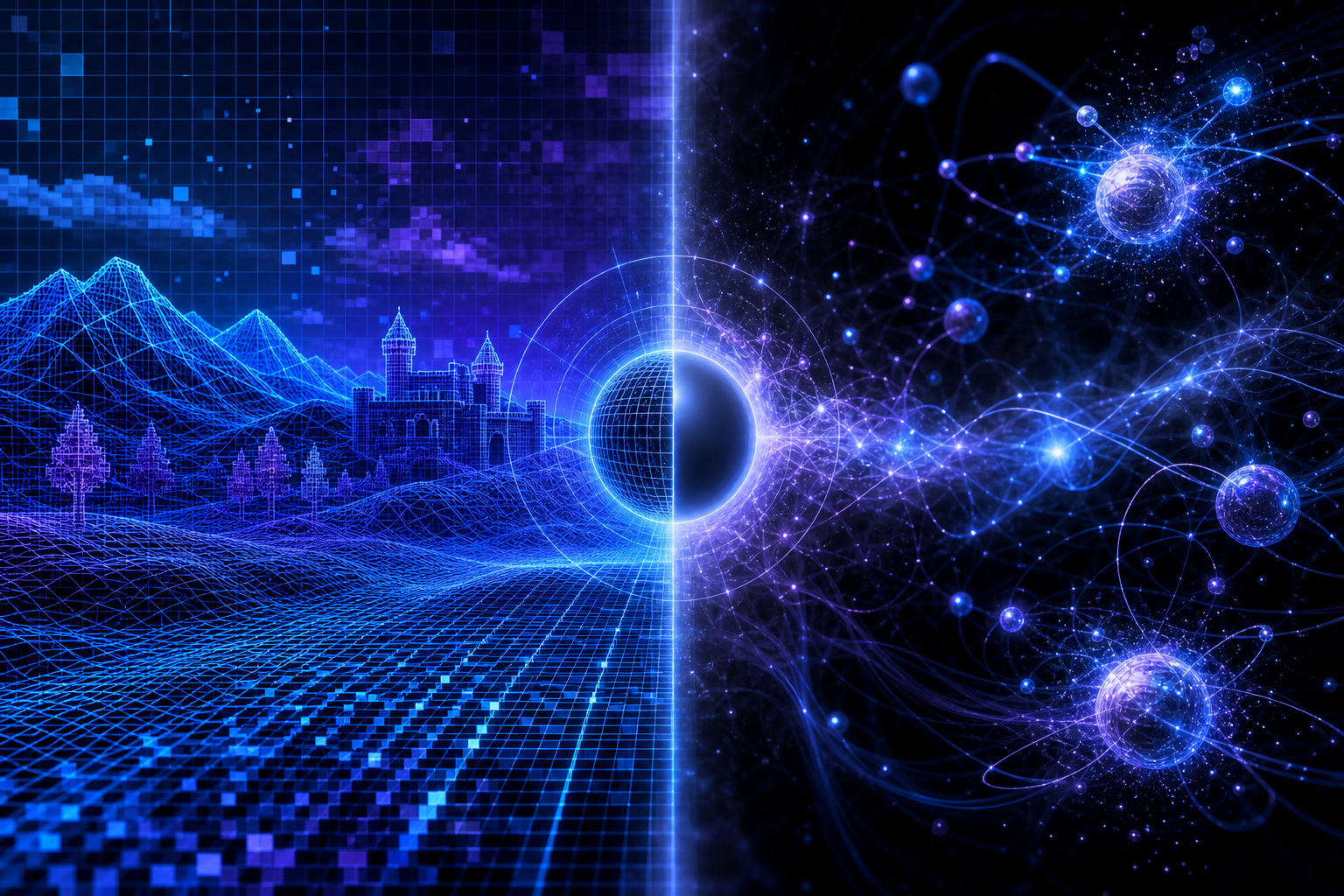
Quantum Mechanics and Simulation — The Parallels
👁️
Lazy Rendering
In a video game, the world only renders the parts the player is currently observing. Off-screen objects exist as potential data, not rendered geometry. Quantum mechanics shows particles exist in superposition until measured — remarkably similar to "lazy loading" or "render on demand." Particles don't have definite properties until something checks.
📡
Information is Fundamental
John Wheeler's "It from Bit" proposes that every physical entity derives its existence from information — from answers to yes/no questions at the quantum level. This is exactly how simulations work: bits underlie everything. The physical world is downstream of information, not the other way around.
🔗
Non-Locality
Entangled particles show instantaneous correlations across any distance. In a simulation, distance is an emergent property of the code, not a fundamental constraint on computation. Non-locality would be expected in a simulation where space is implemented, not fundamental.
🔲
Pixelation at Planck Scale
Space and time appear to be discrete at the Planck scale (~10⁻³⁵ meters, 10⁻⁴³ seconds). Below these scales, current physics breaks down. This resembles a minimum resolution limit — the smallest pixel. Simulations always have a minimum resolution; perhaps so does ours.
🚀
Speed of Light as Clock Speed
The speed of light is an absolute maximum — nothing can exceed it. In computing terms, this resembles a processing speed limit: the maximum rate at which information can propagate through the simulation. Why should there be a speed limit at all, in a purely physical universe?
🎲
Quantum Randomness
True randomness in quantum mechanics — the unpredictable outcome of a measurement — resembles procedural generation or pseudo-random number generation in a simulation. Or genuine randomness could reflect the irreducible indeterminism of a non-simulated quantum universe. Both interpretations fit the data.
Key Thinkers
🤔
Nick Bostrom (2003)
"Are You Living in a Computer Simulation?" — The original philosophical argument. Bostrom's trilemma: either (1) almost all civilizations go extinct before reaching simulation capability, (2) almost no advanced civilizations run ancestor-simulations, or (3) we are almost certainly living in a simulation. If posthuman civilizations exist and run many simulations, we are statistically likely to be simulated.
👁️
Donald Hoffman
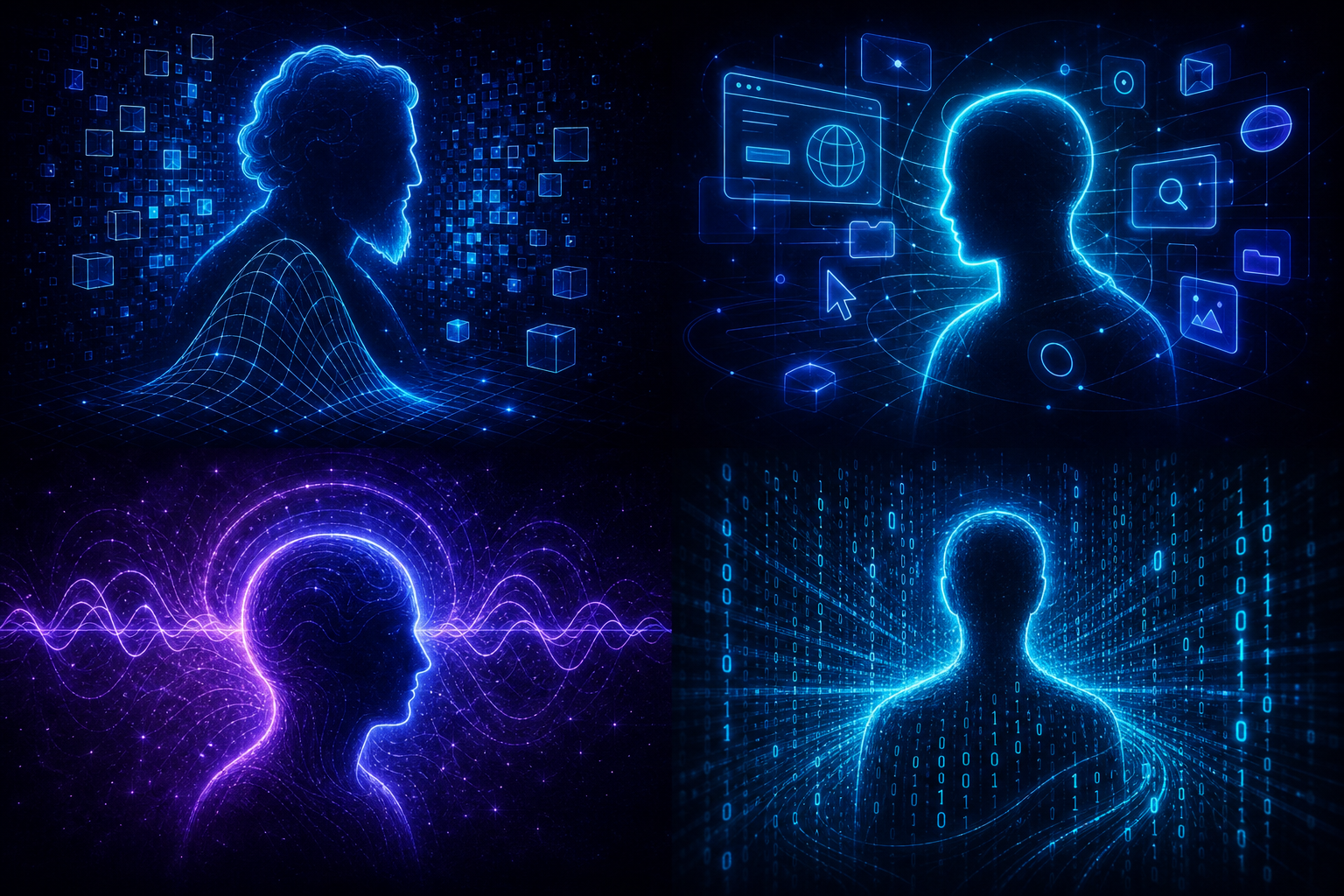
Cognitive scientist at UC Irvine. Argues that reality is a user interface evolved for fitness, not truth — space, time, and objects are icons on a "desktop" we evolved to navigate, not the underlying reality. Quantum mechanics, for Hoffman, is evidence that our perceptions do not reveal objective reality. His research uses evolutionary game theory to show fitness-maximizing perceptions routinely mask true reality.
💻
Tom Campbell
Physicist and author of My Big TOE. Proposes that reality is a virtual simulation and consciousness is fundamental — the physical world is a data stream delivered to individuated units of consciousness. The observer effect and delayed-choice experiments are, for Campbell, predicted by his model: a simulation would only render to observing entities.
⚛️
John Wheeler
Princeton physicist who coined "It from Bit" and proposed the Participatory Universe: observers are necessary to bring the universe into being. His delayed-choice thought experiment (the precursor to Kim et al.) was designed to probe exactly this: does the past require the future to make it real? Wheeler believed information — not matter or energy — is the ground of being.
Arguments For the Simulation Hypothesis

Why Some Physicists and Philosophers Take It Seriously

  • Fine-tuning of physical constants: The constants of physics (electron charge, gravitational constant, cosmological constant) appear finely tuned for complex structure. This is consistent with designed parameters.
  • Discrete space-time at Planck scale: Fundamental discreteness resembles minimum pixel resolution
  • Maximum speed of light: An absolute speed limit resembles a processing constraint
  • Quantum randomness: The universe appears to use random number generation at the fundamental level
  • Observer effect: Reality only "resolves" when information is gained — consistent with a rendering engine that only computes what is checked
  • Non-locality: Entanglement correlations over any distance suggest space is not fundamental to the underlying substrate
  • Information-theoretic formulations of physics: Holographic principle, black hole information paradox solutions, and quantum gravity approaches all suggest information is more fundamental than spacetime
Arguments Against / Counterpoints
🔍
No Glitches or Artifacts
At all observable scales, physics is remarkably consistent and smooth. We don't observe rendering artifacts, computational shortcuts, or inconsistencies that would betray simulation seams. Though critics counter: a well-designed simulation might not have observable artifacts.
💾
Computational Complexity
Simulating quantum mechanics exactly appears to require quantum computation — a simulation would need quantum hardware to simulate quantum physics. But this assumes our physics applies to the simulator. The simulator might run on fundamentally different substrate.
🌲
Many-Worlds Removes Rendering
If Many-Worlds is correct, there is no "lazy rendering" — all possibilities are actualized in branching universes. No observer is needed to resolve reality. This interpretation removes one of the strongest parallels.
⚠️
Decoherence Explains Collapse
Quantum decoherence — the interaction of quantum systems with their environment — explains the apparent collapse of the wave function without requiring any observer or simulator. Sabine Hossenfelder and others argue the delayed-choice eraser is often overhyped as evidence for consciousness or simulation effects.
🔬
Not a Testable Scientific Hypothesis (Yet)
Simulation hypothesis currently makes no unique, testable predictions that differ from a non-simulated quantum universe. Without testability, it is philosophy, not physics. Most working physicists treat it as intellectually interesting but not actionable science.
Infinite Regress
If we're simulated, what is the base reality that runs the simulator? And is that simulated too? The hypothesis defers the mystery rather than solving it — moving "what created reality?" one level up, not answering it.
Where Mainstream Physics Actually Stands

The Honest Assessment

Most working physicists accept the experimental results without endorsing simulation or consciousness-based interpretations. The standard position:

  • The experimental results (double-slit, delayed-choice, Bell inequality violations, entanglement) are robustly established
  • Which interpretation is correct remains genuinely open — Copenhagen, Many-Worlds, Bohm, QBism, and others all fit the data
  • The information-theoretic view (Wheeler, 't Hooft, Verlinde, Jacobson) is taken seriously in quantum gravity research
  • "Simulation" language is useful as metaphor but not yet a testable scientific hypothesis
  • The holographic principle — that all information in a volume can be encoded on its boundary — is mainstream physics and does suggest information is more fundamental than space

The Information-Theoretic View is Mainstream

Even physicists skeptical of simulation talk accept that information appears to be more fundamental than matter, space, or energy. The holographic principle, black hole thermodynamics (Hawking radiation), and quantum gravity approaches all converge on this. "It from Bit" may not mean simulation — but it does mean the universe is deeply computational at its foundation.

Sabine Hossenfelder's Caution

Theoretical physicist Hossenfelder has specifically critiqued the delayed-choice eraser's popular interpretation: "It has been overhyped and does not imply retrocausality or consciousness." Sean Carroll (physicist, Many-Worlds proponent) similarly urges caution about reading too much philosophy into the quantum formalism. The science is real. Some popular interpretations of it are not.

The Bottom Line

The simulation hypothesis is not established science — but it is not mere science fiction either. Serious physicists and philosophers take the question seriously. What the quantum evidence does establish is this: information is fundamental, reality is not what classical intuition says it is, and the role of the observer (or information-gaining process) in physical reality is non-trivial and unresolved. Whether that points to simulation, to a fundamentally informational cosmos, or to something we haven't yet conceived — is one of the most open questions in science and philosophy.

🔮