Quantum Biology
Your body is a quantum machine — and life has been exploiting quantum mechanics for over 3.5 billion years. The warm, wet world of biology is stranger than classical physics ever imagined.
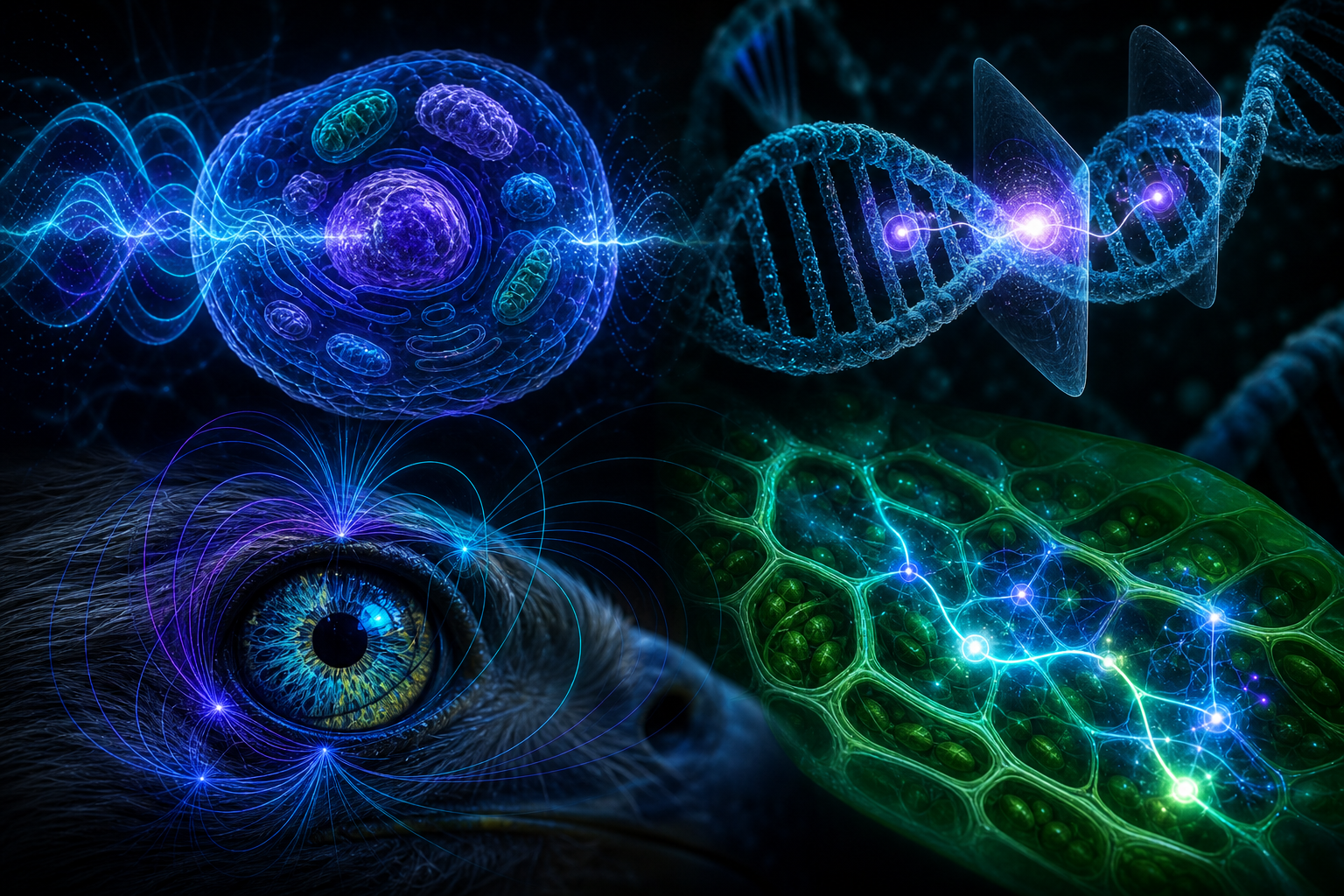
For decades, physicists assumed quantum effects only mattered at cryogenic temperatures — near absolute zero, in perfectly isolated laboratory conditions. Biology, with its warm temperatures, wet environments, and constant thermal noise, seemed to guarantee quantum coherence would collapse instantly. Life was assumed to be purely classical.
That assumption is rapidly collapsing. A wave of research since 2007 — backed by Fleming's lab at UC Berkeley, Hore's lab at Oxford, Klinman's decades of enzyme work, and dozens of others — has shown that life has evolved to exploit quantum mechanics, not despite the warm-wet environment but often because of it.
Near-Perfect Energy Transfer
Plants convert sunlight to chemical energy with astonishing efficiency — often 95% or higher. Classical physics struggles to explain how. The path from the light-harvesting antenna to the reaction center involves complex protein scaffolding, and classical "random hopping" of excitation energy would produce far lower efficiency.
The FMO Complex
In green sulfur bacteria, the Fenna-Matthews-Olson (FMO) complex acts as a quantum wire between the light-harvesting antenna and the reaction center. Research led by Graham Fleming at UC Berkeley (Nature, 2007; PNAS, 2010) revealed:
- Long-lived quantum coherence: Electronic excitations (excitons) maintain quantum phase relationships for hundreds of femtoseconds — long enough to matter biologically, even at physiological temperatures (not just near absolute zero).
- Quantum beating signals: Direct spectroscopic evidence of wavelike energy transfer at both 77 K and room temperature.
- Quantum walk: The exciton explores multiple pathways simultaneously via superposition, finding the most efficient route to the reaction center — dramatically outperforming classical random hopping.
A 2026 analysis confirmed the FMO complex sustains extended coherence long enough to achieve near-maximal entanglement with the reaction center within 5 picoseconds.
Photosynthesis is the foundation of nearly all life on Earth. If quantum coherence is essential to its efficiency, then life has been exploiting quantum mechanics for ~3.5 billion years. Every plant, every blade of grass, every phytoplankton — all running quantum algorithms optimized by evolution.
The Radical Pair Mechanism
Migratory birds navigate thousands of miles with precision that challenges classical explanation. The Earth's magnetic field is ~50 microtesla — far too weak to directly affect ion channels or magnetic particles in the way classical magnetoreception would require. Yet birds navigate with extraordinary accuracy.
The answer may lie in cryptochrome 4 proteins in birds' retinas. When blue light hits these proteins, it creates radical pairs: two electrons, separated across molecules, in entangled spin states. Because their spins are quantum-correlated, they are exquisitely sensitive to the direction of the Earth's magnetic field.
Recent Experimental Confirmation (2024–2025)
- 2024 Nature Communications: The Quantum Zeno effect stabilizes magnetosensitivity in tightly bound radical pairs — a specific quantum mechanism enabling the compass.
- 2025 (Guardian-reported): Robin cryptochrome 4 showed significantly higher magnetic sensitivity than chicken versions. Mutating the candidate radical-forming sites eliminated the effect — directly confirming the mechanism.
- 2024 Journal of the Royal Society Interface: Radiofrequency disruption experiments show the magnetic sense can be scrambled by precisely the frequencies that would interfere with radical-pair quantum coherence.
The proposed mechanism involves avoided crossings in spin energy levels — creating sharp directional sensitivity that functions as a precise compass. Birds may literally see the Earth's magnetic field as an overlay on their visual experience — a quantum sense evolved over millions of years.

Reactions That Shouldn't Be Possible
Enzymes accelerate biochemical reactions by factors of up to 10¹⁷. For decades, biochemists explained this through classical transition-state theory: enzymes lower the activation energy barrier, allowing reactions to proceed at biological temperatures.
Judith Klinman's decades of work at UC Berkeley revealed a deeper story. Many enzymes don't just lower barriers — they allow particles to tunnel through them.
Hydrogen Tunneling
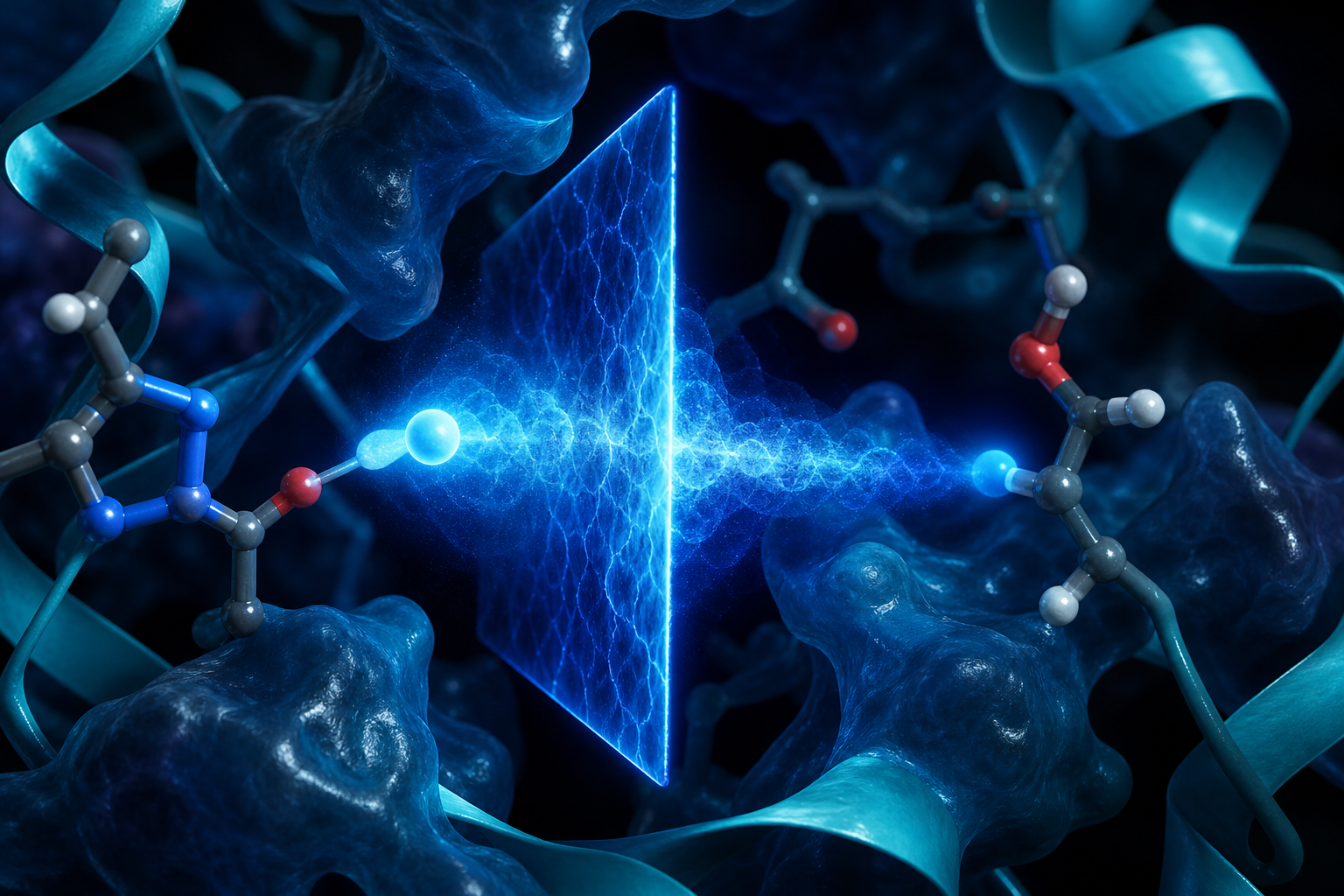
Many enzyme-catalyzed reactions involve cleaving a carbon-hydrogen (C-H) bond. Classically, the hydrogen atom must surmount an energy barrier to transfer. Quantum mechanically, the hydrogen's wave function can extend through the barrier — and it can appear on the other side without ever "going over" the barrier. This is quantum tunneling.
Klinman's key evidence: temperature-independent kinetic isotope effects — measured differences in reaction rates between hydrogen and its heavier isotope deuterium — that are inconsistent with classical transition-state theory. When you swap hydrogen for deuterium (which tunnels less effectively due to its greater mass), the reaction rate drops in a way that only makes sense if tunneling is happening.
Furthermore, enzymes appear to have evolved protein dynamics that actively enhance tunneling: protein motions compress the donor-acceptor distance to optimize the tunneling probability. Evolution didn't just tolerate quantum tunneling — it optimized for it.
"Hydrogen tunneling links protein dynamics to enzyme catalysis" — Accounts of Chemical Research. Tunneling is not a curiosity. It is central to how life drives chemical reactions.
Shape vs. Vibration
Standard olfaction theory holds that smell works like a lock-and-key: odorant molecules physically fit into receptor binding sites based on their shape. Different shapes → different smells.
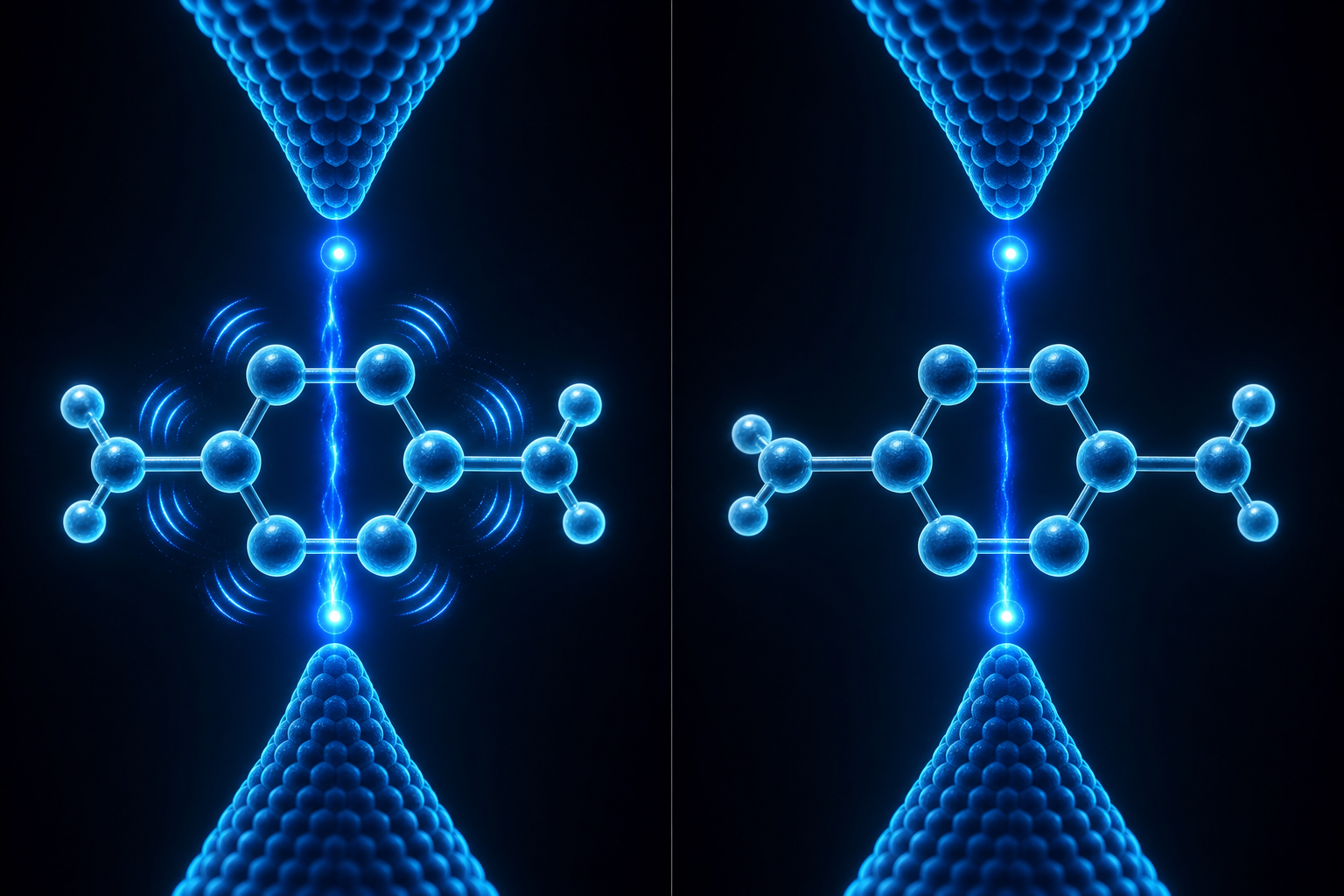
Luca Turin proposed a radical alternative: the vibration theory. He argues that smell receptors detect molecular vibration frequencies via inelastic electron tunneling — electrons tunnel from the receptor to the odorant molecule, but only if the odorant's molecular vibration absorbs the electron's energy at the right frequency.
Intriguing Evidence
- Isotopomers — same molecular shape, but with hydrogen replaced by deuterium, altering only vibrational frequencies — can smell different in human trials
- Some molecules with similar shapes but different vibrations produce distinct smells
Current Status (Mixed)
Recent studies (2025–2026) on human musk receptor OR5AN1 and mouse thiol receptor found no support for vibration-based detection in those specific cases. Shape theory likely dominates for many receptors. Vibration theory remains plausible for specific cases but contested. The debate continues — but even a partial role for quantum tunneling in smell would mean one of our most ancient senses exploits subatomic physics.
The Penrose-Hameroff Theory
Roger Penrose (Oxford mathematician, two-time Fields Medal-adjacent laureate) and Stuart Hameroff (University of Arizona anesthesiologist) proposed Orchestrated Objective Reduction (Orch-OR): consciousness arises from quantum processes in neuronal microtubules.
Core Claims
- Microtubules — protein lattices inside neurons — support coherent quantum states
- These states perform non-computable operations via objective reduction: Penrose's proposed gravitational collapse mechanism for wave function collapse
- "Orchestration" by synaptic activity links quantum computation to classical neural firing
- This could explain the binding problem, the continuity of experience, and why anesthesia works (general anesthetics may target microtubule quantum states)
Recent Evidence (2024–2025)
- 2025, Neuroscience of Consciousness: "Intraneuronal microtubules as functional targets of inhalational anesthetics; collective quantum states solve binding and epiphenomenalism problems"
- 2025, Current Research in Neurobiology: Quantum active inference naturally accounts for discrete perceptual cycles via Orch-OR dynamics
- Experimental support for microtubule quantum coherence at biological temperatures remains limited but growing
The Controversy
Orch-OR is highly controversial. Critics argue decoherence times in warm, wet neurons are too short for quantum computation to be relevant. Supporters argue that: (1) new evidence shows quantum effects in warm biology are more robust than assumed, (2) anesthetics do appear to target microtubules, and (3) no purely classical theory has satisfactorily explained consciousness.
If Orch-OR is correct, consciousness is not an emergent classical computation — it is a fundamental quantum process, potentially placing mind at the heart of how reality collapses from superposition. The observer in quantum mechanics would not be a passive recorder but a participant in the most literal sense.
Proton Tunneling and Mutations
In DNA's double helix, bases are paired by hydrogen bonds: A-T and G-C. These bonds involve protons (hydrogen nuclei) that can sometimes quantum-tunnel between configurations, creating rare tautomeric forms — base pairs in unusual chemical arrangements.
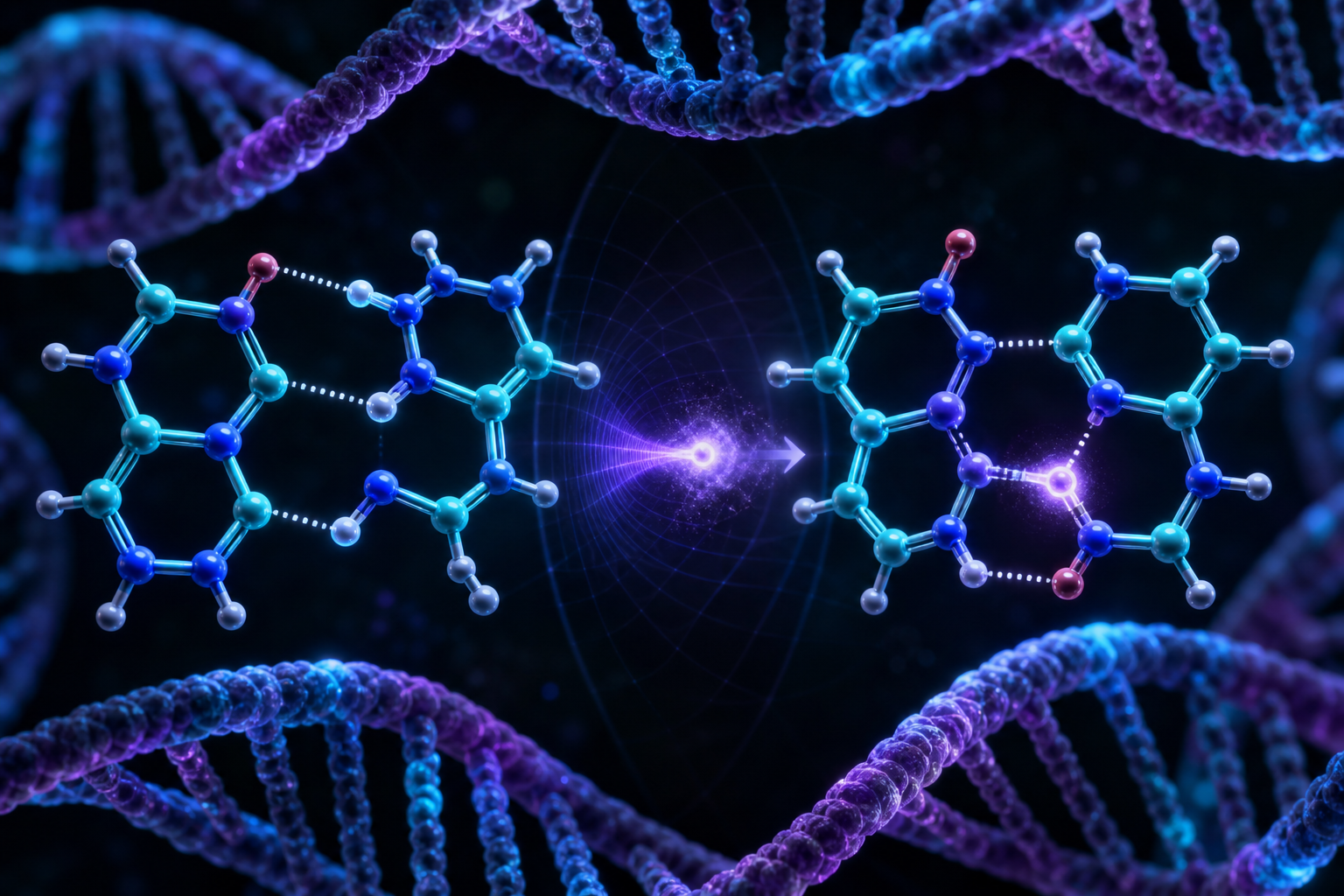
When DNA replicates and a tautomeric base pair is present, it can cause the wrong base to be inserted — a spontaneous mutation. Classical physics predicts tautomeric forms should be vanishingly rare. Quantum tunneling may make them more common than classical models predict.
Recent Research
- 2022, Communications Physics: Open quantum systems modeling shows tunneling rates exceed classical barrier-hopping in G-C pairs
- 2023, Journal of Physical Chemistry Letters: Tunneling-ready configurations increase proton transfer rates 100-fold; tautomeric occupation probability ~1.73 × 10⁻⁴
- 2024, Scientific American: "Quantum Tunneling Makes DNA More Unstable Than Classical Models Predict"
The implication is profound: evolution itself may be partially quantum-driven. The mutations that fuel natural selection — the raw material of all evolutionary change — may include irreducible quantum indeterminacy. The randomness is not merely classical noise. It is quantum uncertainty, written into the history of life.
Life Exploits Quantum Mechanics Across Six Domains
- Energy efficiency: Photosynthesis uses quantum coherence (quantum walk) for near-perfect energy transfer
- Navigation: Birds achieve precise magnetic navigation via entangled radical pairs in cryptochrome proteins
- Catalysis: Enzymes harness proton tunneling for reaction rates impossible by classical physics, and evolved proteins to enhance tunneling
- Smell: Possibly vibration-based electron tunneling (contested but plausible)
- Consciousness: Orch-OR proposes quantum computation in microtubules underlies subjective experience (controversial but serious)
- Genetics: Proton tunneling in DNA base pairs may contribute to the mutation rate that drives evolution
The picture that emerges is that life does not merely tolerate quantum mechanics — it appears to have evolved to exploit it at multiple levels, from cellular to organismal. We are not passive passengers in a quantum universe. We are built from quantum fabric, running quantum algorithms, shaped by quantum randomness.
And if the Penrose-Hameroff theory is even partially correct, then the boundary between "observer" and "observed" — already blurred by the double-slit — becomes biologically entangled. We don't just watch quantum mechanics. We are quantum mechanics, experiencing itself.