The Double Slit
The foundational experiment that changed everything. Where a single particle defeats common sense and forces physics to confront the nature of reality itself.
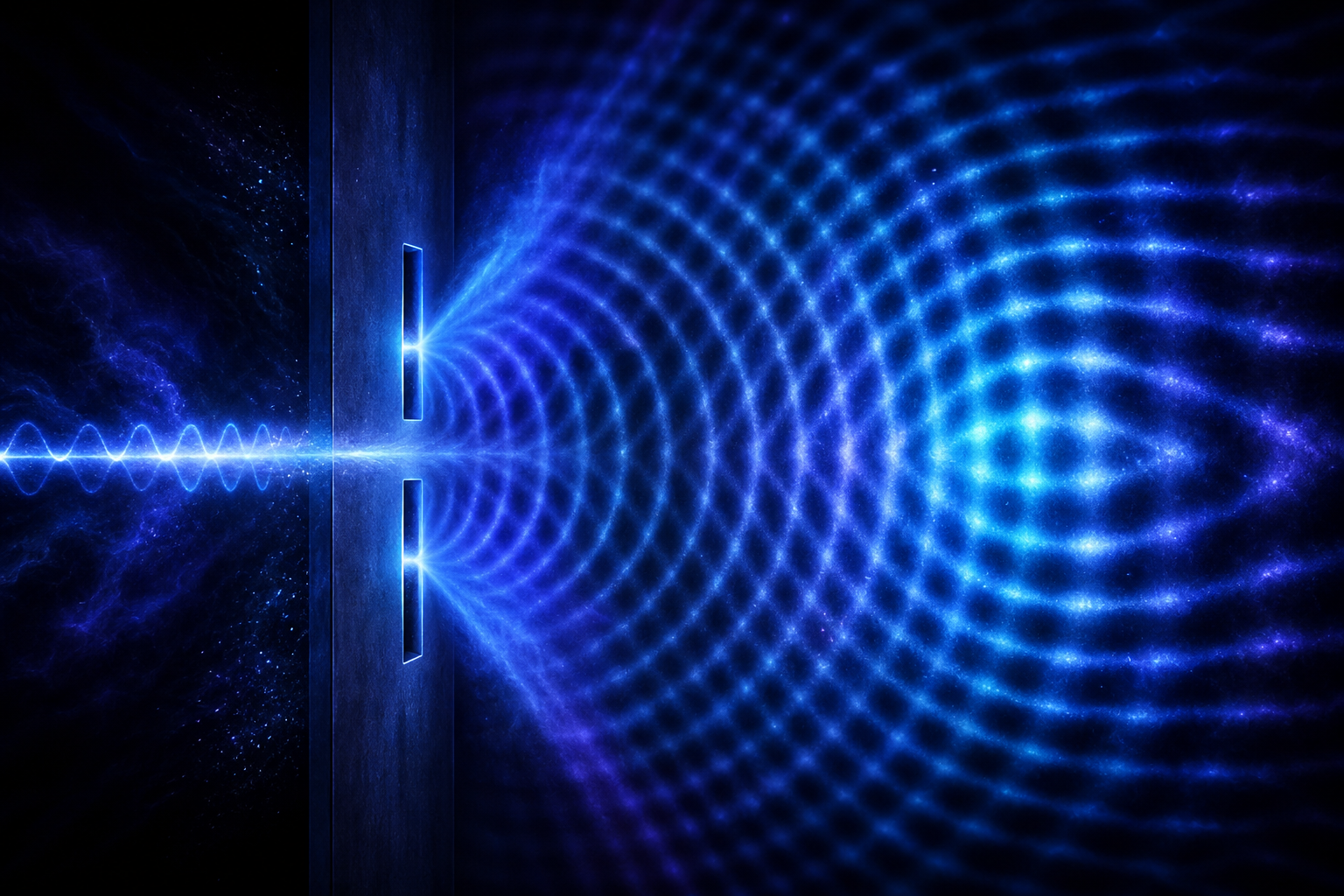
Take a laser and shine it at a thin barrier with two narrow slits cut into it. Behind the barrier, place a detection screen. Simple enough. Now watch what happens.
When you fire photons through without checking which slit each one passes through, the light creates an interference pattern on the screen behind — alternating bands of bright and dark, exactly like two overlapping water waves. This is wave behavior. The photon appears to travel through both slits simultaneously and interfere with itself.
Now add a detector at the slits to record which path each photon takes. The interference pattern vanishes. Photons now land in two distinct clumps — one behind each slit. The behavior has changed from wave to particle. Not because the detector physically disturbs the photons. Because the information of which path was taken became available.
The act of measurement — gaining "which-path" information — fundamentally changes the physical behavior of reality at the quantum scale. The photon does not have a definite path until measured. This is not a limitation of our instruments. This is a feature of nature itself.
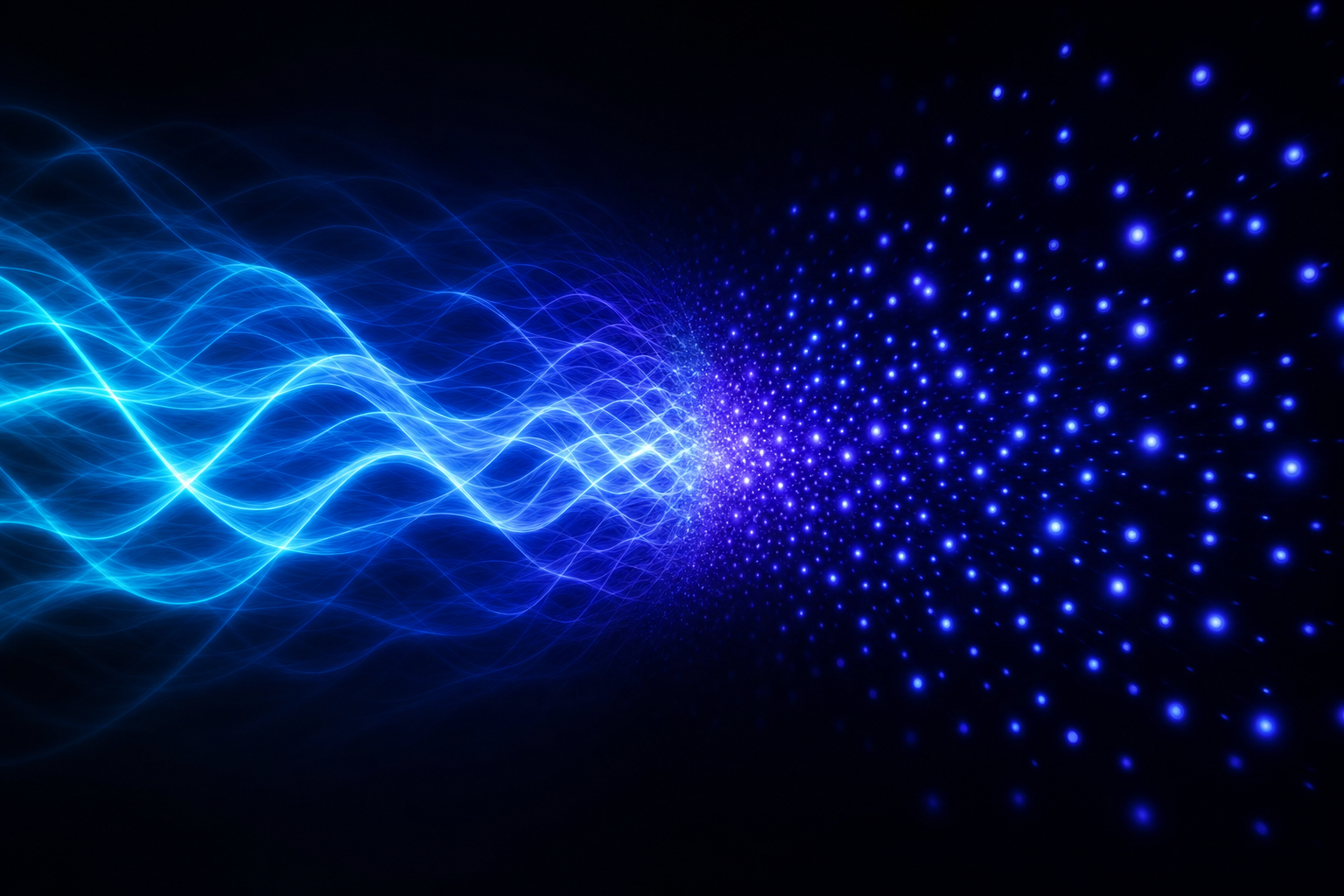
This duality is not limited to photons. Electrons, protons, atoms, and even large molecules (Buckminsterfullerene, C₆₀, containing 60 carbon atoms) have been shown to produce interference patterns. The quantum description applies to all matter.
The wave function encodes probabilities, not certainties. Until measurement, there is no fact of the matter about which slit the particle took. The question "which slit did it really go through?" has no answer — not because we lack the measurement, but because nature has not decided yet.
The Central Unsolved Mystery
The double-slit experiment creates what physicists call the measurement problem: the deepest unsolved conceptual issue in quantum mechanics.
What exactly constitutes a "measurement"?
The wave function evolves smoothly and continuously according to Schrödinger's equation — until "measurement" occurs, at which point it appears to collapse instantly to a definite outcome. But when? At what point does the collapse happen?
- When the photon interacts with the detector material?
- When the detector records a signal?
- When a human reads the result?
- When the information becomes irreversibly stored anywhere in the universe?
No consensus answer exists. Different interpretations of quantum mechanics answer this question in radically different ways — and each interpretation implies a different picture of what reality fundamentally is.

The dominant interpretation for most of the 20th century, developed by Niels Bohr and Werner Heisenberg in Copenhagen during the late 1920s. Its central claim: the wave function evolves deterministically via Schrödinger's equation right up until a measurement occurs — at which point it collapses instantaneously to a definite outcome. Before measurement, a particle has no definite position, momentum, or path. After measurement, it does. The act of measuring is what makes properties real.
What counts as a "measurement" is deliberately left undefined — and this is arguably the point, not a flaw. Bohr's complementarity principle holds that wave and particle properties are mutually exclusive aspects of the same entity: you can design an experiment to observe one or the other, but never both simultaneously. Copenhagen is explicitly anti-realist about unobserved quantum systems. You are not supposed to ask what the particle was doing between measurements. The physics only describes what we observe.
This pragmatic stance has served experimental physics superbly for a century — all predictions hold. But critics say it defers rather than solves the measurement problem: what exactly triggers collapse? When the detector clicks? When a human sees the result? Copenhagen's answer — that the question has no physical meaning — has never fully satisfied. The famous injunction often attributed to Feynman, "shut up and calculate," captures both Copenhagen's strength and its philosophical evasiveness.
Proposed by Hugh Everett III in his 1957 Princeton PhD thesis — and largely ignored for two decades. Everett's insight: Schrödinger's equation never says when or why collapse happens. That's because it doesn't happen. The equation always applies, to everything, at all scales. There is no collapse. There is only the continuously evolving universal wave function, branching at every quantum event.
When you measure a photon and find it went left, you have become entangled with the "went left" branch of the wave function. In another equally real branch, a version of you found it went right. Both outcomes occur. Both versions of you are real. They are simply causally disconnected — no signal can pass between branches. The universe is not a single narrative but an exponentially branching tree of equally actualized histories. All possibilities are real. You experience one branch.
Many-Worlds has gained popularity among theoretical physicists precisely because it requires no additional collapse postulate and treats the wave function as a fundamental physical object rather than a mere bookkeeping tool. The cost is ontological extravagance: an unimaginable proliferation of unobservable parallel universes. Proponents argue this is the honest price of taking the mathematics seriously. The wave function of the universe is all that exists — and it doesn't collapse. It just keeps going.
First proposed by Louis de Broglie in 1927 as the "pilot wave" theory, then comprehensively developed by David Bohm in 1952 after the physics community had dismissed it. Bohmian mechanics restores what Einstein always wanted: particles have definite positions at every moment. There is no superposition in the sense of a particle being "in two places at once." Particles are always particles. They just follow strange, wave-influenced trajectories.
A real physical wave — mathematically identical to Schrödinger's wave function — pervades all of space and guides each particle along its trajectory via what Bohm called the quantum potential. In the double-slit experiment, the pilot wave itself passes through both slits, creates an interference pattern, and channels the particle into the bright bands. The particle always goes through one slit. But the wave goes through both, and that wave shapes where the particle ends up. The interference pattern emerges because of the wave's guidance — not because the particle is in superposition.
The randomness we observe is not fundamental: it is epistemic, arising from our ignorance of the particle's exact initial position. A fully informed observer (in principle) could predict every outcome. The theory is fully deterministic. But the price is genuine, built-in non-locality: the pilot wave must respond instantaneously to distant events to guide particles correctly. When which-path information is obtained, the wave changes globally — across the entire apparatus, instantly. Bohm viewed this not as a flaw but as evidence of an "implicate order," a deeper connected reality underlying the apparent separateness of the classical world.
Quantum Bayesianism — shortened to QBism — was developed primarily by physicist Christopher Fuchs along with Carlton Caves and Rüdiger Schack in the early 2000s. QBism makes a radical move: the wave function is not a property of a quantum system. It is a representation of an agent's personal, subjective probability assignments — a catalog of their beliefs about what experiences they will have when they interact with a system.
In this view, "collapse" is not a physical event at all. When a physicist measures a particle and gets a result, they update their wave function — exactly as a Bayesian statistician updates a probability distribution upon receiving new data. The update happens in the agent's mind, not in the particle. Two physicists can legitimately assign different wave functions to the same system, and both can be correct — because the wave function reflects their different states of knowledge, not the system's objective state. There is no shared, observer-independent quantum state.
QBism resolves the measurement problem by denying that collapse is a problem at all: it is simply rational belief-updating. The price is radical: physics becomes explicitly a first-person science. It describes how agents navigate their experience, not how an external world exists independently of observers. Critics find this too subjective or solipsistic; QBists respond that it is simply honest about what quantum mechanics actually is — a tool for agents to manage their interactions with the world, not a God's-eye view of reality. Philosophically, QBism aligns with pragmatism, and its emphasis on subjective experience resonates with broader debates in philosophy of mind and consciousness.
Every interpretation agrees on the experimental predictions — they all pass the same tests. They disagree on what those experiments mean about the nature of reality. This is not a scientific dispute. It is a philosophical one. And it remains unresolved a century after quantum mechanics was formulated.
What the Double-Slit Experiment Establishes
- Reality at the smallest scales is probabilistic, not deterministic — before measurement, outcomes are genuinely undetermined
- Observation and reality are inextricably linked — the availability of information changes physical outcomes
- Particles do not have definite properties (position, momentum, path) until those properties are measured
- Wave-particle duality applies to all matter, not just light
- The boundary between "quantum" and "classical" is fuzzy — quantum effects persist into the macroscopic world
- These are experimentally verified facts, not philosophical speculation — they underpin all modern quantum technologies
The double-slit experiment is not a historical curiosity. It is the foundation on which lasers, transistors, MRI machines, solar cells, LED lights, and quantum computers rest. Every device that exploits quantum mechanics ultimately traces back to the reality this single experiment revealed.
The next experiment pushes even further. What if the decision to measure happens after the photon has already passed through the slits — and hit the screen?