The Quantum Eraser
What if the decision to measure happens after the photon already passed through the slits — and the past changes? The delayed-choice quantum eraser, and what it reveals about information, time, and reality.

The double-slit experiment shows that knowing which slit a photon passes through destroys the interference pattern. The delayed-choice quantum eraser asks a more unsettling question: what if we decide whether to measure the which-path information after the photon has already hit the detection screen?
The answer, confirmed in multiple experiments since 1999, is profoundly strange: the retroactive choice appears to determine whether an interference pattern is present in the correlated detections. Past behavior seems to depend on future decisions — at least, that is how it looks before you understand how the math actually works.
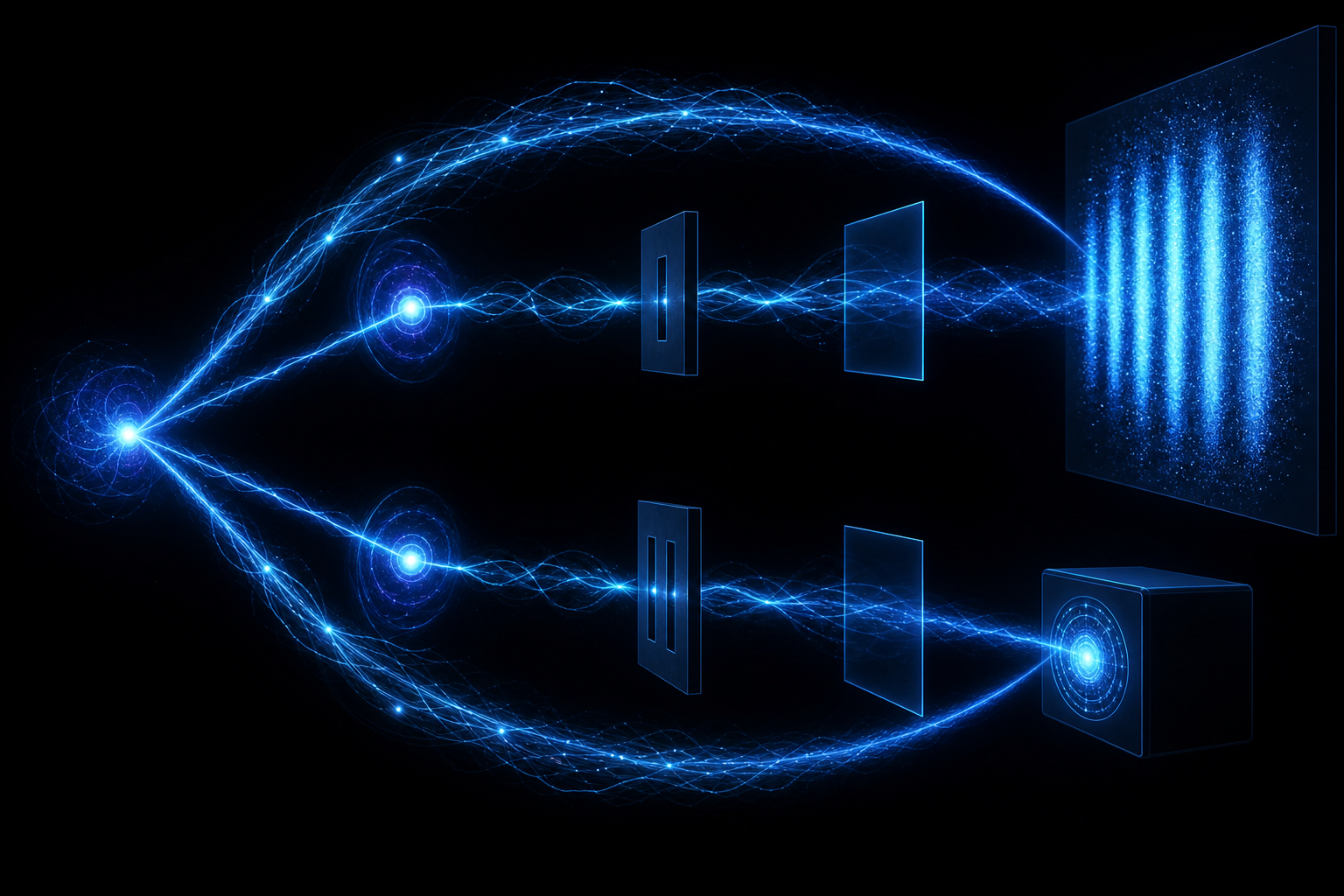
The Kim et al. (1999) experiment is complex, but its logic follows a clear thread. Here is what actually happens, physically, step by step.
A laser fires photons one at a time at a double-slit. Instead of traveling directly to a screen, each photon passes through a BBO crystal (beta barium borate) — a nonlinear optical crystal that converts one photon into two entangled photons via spontaneous parametric down-conversion. These two photons are quantum-mechanically linked: whatever you learn about one instantly constrains what you will find when you measure the other.
One of the pair — the signal photon — travels directly to detector D₀, a screen that records where it lands. Its position is logged. At this point, the signal photon has already completed its journey. Its mark on the screen is made.
The other — the idler photon — travels a longer, deliberately extended path through a series of mirrors and prisms. The path is engineered so that the idler arrives at its detectors after the signal photon has already hit the screen. By the time the experimenter decides what to do with the idler, the signal photon’s fate is already recorded.
At the end of the idler’s path, a beam splitter sends it toward one of several detectors. Detectors D₃ and D₄ are positioned to preserve which-path information: a click at D₃ tells you the idler came from slit A; a click at D₄ tells you it came from slit B. Detectors D₁ and D₂ are reached through a configuration that erases the which-path information — the paths are mixed before detection, so a click tells you nothing about which slit the original photon came from.
Here is the result: looking at the D₀ screen alone, you see no interference pattern — just a blur. But when researchers sort the signal photon data after the fact based on what the idler photon did, two distinct sub-patterns emerge. Signal photons whose idler partners hit D₁ or D₂ (erasure) form an interference pattern — fringes, wave behavior. Signal photons whose idler partners hit D₃ or D₄ (which-path preserved) form two clumps — particle behavior. The behavior of the signal photon appears correlated with a decision made after it had already landed.
The critical constraint preventing time travel: the interference pattern is invisible until you sort by the idler outcomes. You cannot see it by looking at the signal data alone. The correlation only becomes visible after comparing both sets of records — which means no information travels backward in time. The future does not cause the past in any usable sense. But the correlations between entangled photons span both space and the sequence of detection events in a way that defies any classical picture of what "happened" to the photon.
Looking at the signal detector alone, you see no interference pattern ever. The interference only emerges when you sort the signal photon data after the fact, based on what happened to the idler. No faster-than-light signaling is possible. No message can be sent to the past. The correlations only become meaningful in retrospect, after comparing both detectors.

What the Eraser Experiment Reveals
The experiment reinforces something profound from the double-slit: it is the availability of which-path information that determines behavior, not any physical disturbance to the photon. If information about a path exists anywhere in the universe — even in a detector the photon never touched — the interference vanishes. Erase that information, and it returns.
More radically: the erasure happens after the signal photon lands, yet the sorted coincidence data shows that the signal photon "behaved" appropriately. This suggests that in some meaningful sense, quantum events do not have definite properties until the information is completely settled — even if that settling happens in the future.
John Wheeler interpreted this as evidence for a participatory universe: observers (or information-gaining interactions) do not merely discover pre-existing properties — they participate in bringing reality into definite form.
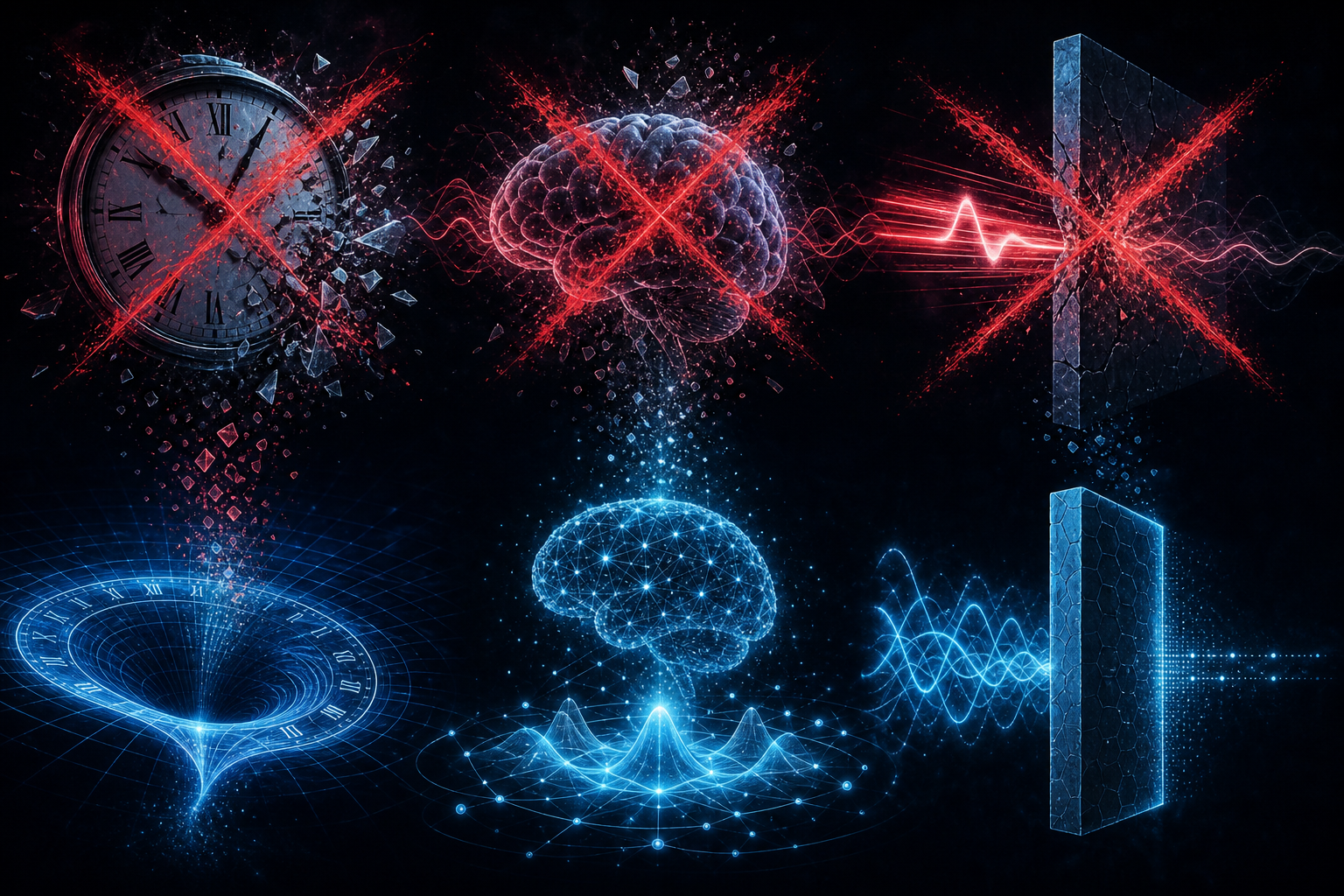
The delayed-choice quantum eraser does not allow time travel. It does not prove consciousness creates reality. What it does show — unmistakably — is that quantum reality is deeply entangled with information, that "when" something is determined is not always before "when" it happened in our intuitive sense, and that non-local correlations between entangled particles are real, verified, and not explainable by any local hidden variable theory (per Bell's theorem). Reality at the quantum level is genuinely strange.