48 Dimensions
They found 48-dimensional topological structures hiding in ordinary light. Over 17,000 distinct signatures — always present, invisible until 2025. What this means for quantum technology and our understanding of space.
In early 2025, researchers at the University of the Witwatersrand (South Africa) and Huzhou University (China), led by Professor Andrew Forbes and Professor Robert de Mello Koch, published a paper that rewrote the rulebook for high-dimensional quantum states.
Using one of the most common techniques in quantum optics labs worldwide — spontaneous parametric down-conversion (SPDC) — to generate entangled photon pairs, they measured a single property of the light: its orbital angular momentum (OAM).
What they found inside that one property stunned the field. The photons contained topological structures spanning 48 dimensions, with more than 17,000 distinct topological signatures. These structures had been present in routine experiments for decades. Nobody had looked for them. Nobody had found them. They were always there.
Ornelas, P., et al. (2025). "The topological spectrum of high dimensional quantum states." arXiv:2503.12540. Published March 2025; reported widely in scientific press March–April 2026.
To appreciate these numbers, consider the context. Most quantum information experiments work with two-level systems — qubits with two possible states: 0 and 1. Entangling two qubits gives you 4 correlated states. Entangling 10 gives you 1,024. This is already considered remarkably rich.
The Forbes/de Mello Koch discovery found 48 distinct dimensions of topological structure in a single property of a single entangled photon pair — generated by equipment that thousands of labs have been running for decades. The 17,000+ distinct signatures are not different experiments or different setups: they are distinct structures encoded in the same light, waiting to be read.
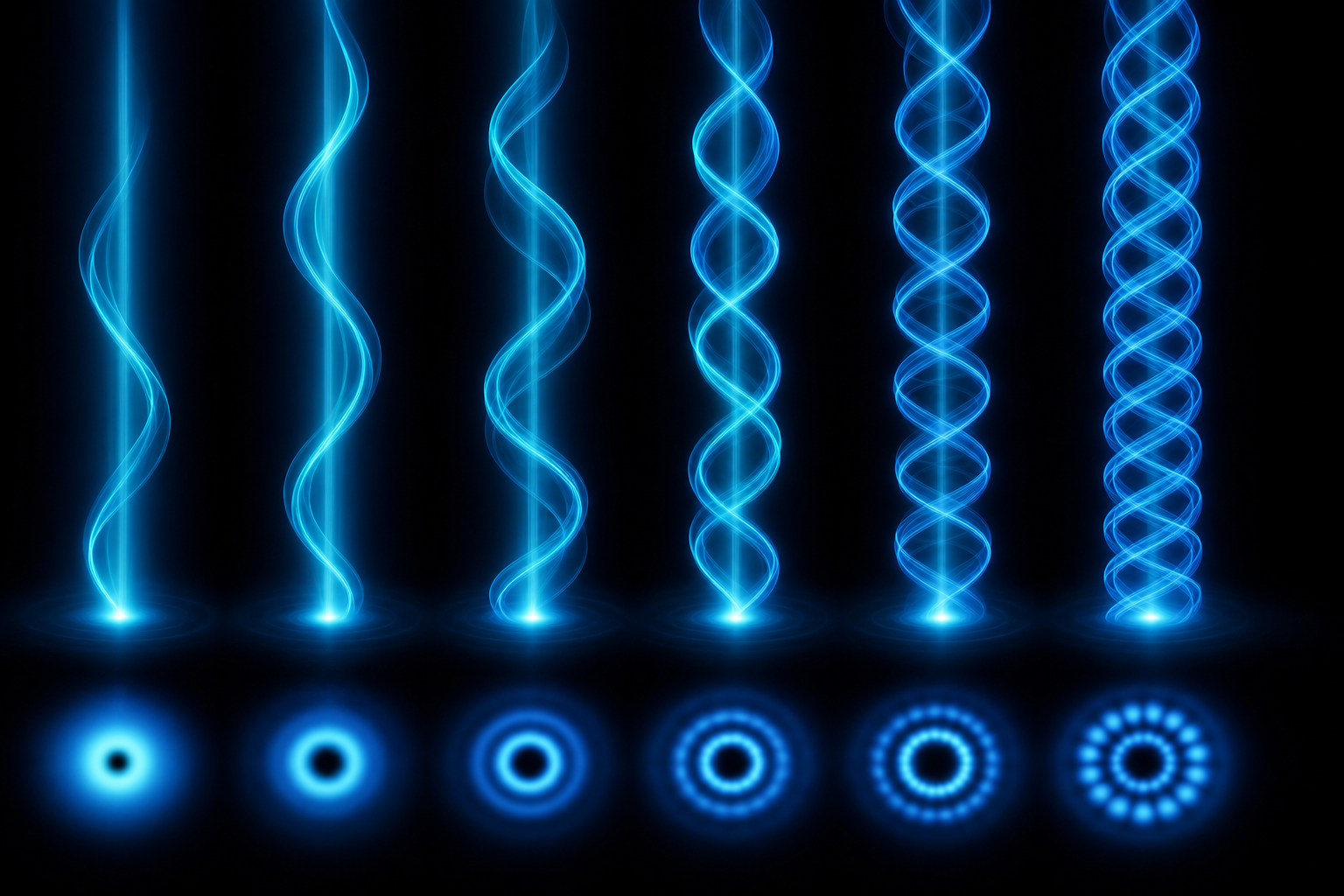
The ∞ in the third card is not hyperbole. Orbital angular momentum can take any integer value: …−3, −2, −1, 0, +1, +2, +3… with no upper bound. Because OAM is unbounded, the topological structures it generates can, in principle, extend to arbitrary dimensions. The 48-dimensional finding is a lower bound observed in one experiment — not a ceiling.
Topology in Plain Language
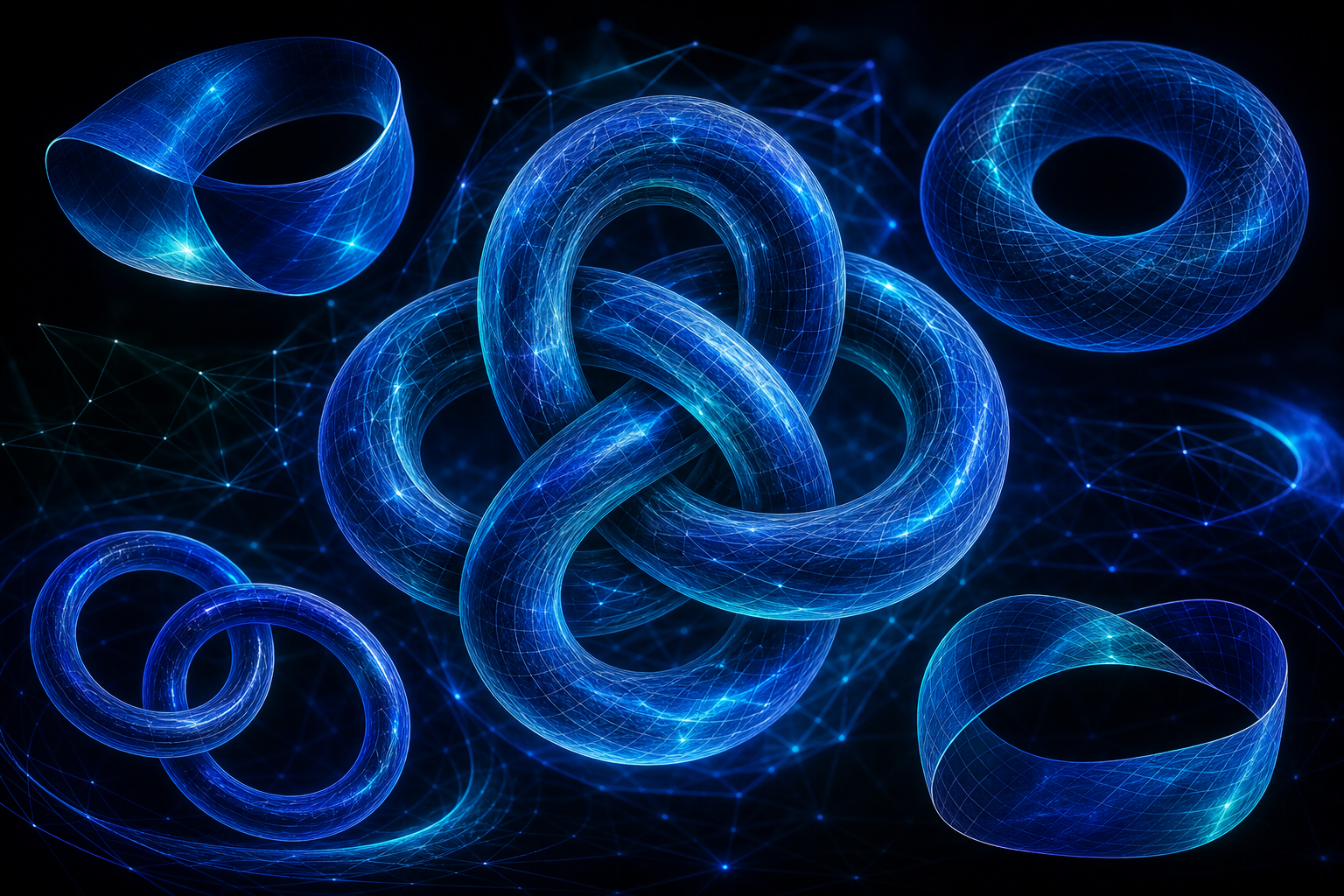
Topology is the branch of mathematics that studies properties preserved under continuous deformation — stretching and twisting are allowed, but not tearing or cutting. The classic example: a coffee cup and a donut are topologically identical (both have one hole). A sphere is topologically different (no holes).
In quantum information, topological properties are inherently robust. Because they are defined by global structure rather than local details, small disturbances — the noise and decoherence that plague quantum computers — cannot change them. A "topological invariant" cannot be changed without tearing the quantum state apart.
The Topological Spectrum
In classical topology, a single number often characterizes the topology (the number of holes, for instance). In these 48-dimensional quantum states, topology is described by a rich spectrum of values — not one number, but a multi-dimensional fingerprint.
The researchers describe this as a vast new "alphabet" for encoding quantum states. Where previous schemes had a handful of letters, this alphabet has more than 17,000. Each signature is distinct, robust, and — crucially — accessible using equipment already standard in quantum optics labs.
"You get the topology for free, from the entanglement in space. It was always there, it just had to be found."
This is perhaps the most remarkable aspect of the discovery. SPDC — the technique that produces these entangled photons — is performed in quantum optics labs around the world, every day. Researchers have been generating these photons for decades. The topological structures were present in every one of those experiments. Nobody measured for them.
The implications are significant: not only did science miss something enormous in routine experiments, but it suggests that quantum states carry far richer structure than we typically access. Reality may be encoding more information in every quantum event than our standard toolkit reveals.

Summary: What Was Found
- 48-dimensional topological structures in entangled photon pairs generated by standard SPDC technique
- More than 17,000 distinct topological signatures, all accessible from a single property (OAM)
- Discovery overturns assumption that topology requires at least two independent properties
- OAM's unlimited discrete spectrum enables topologies of extraordinary dimension
- Structures were present in decades of existing experiments — waiting to be noticed
- Opens new encoding methods, topological protection strategies, and communication protocols