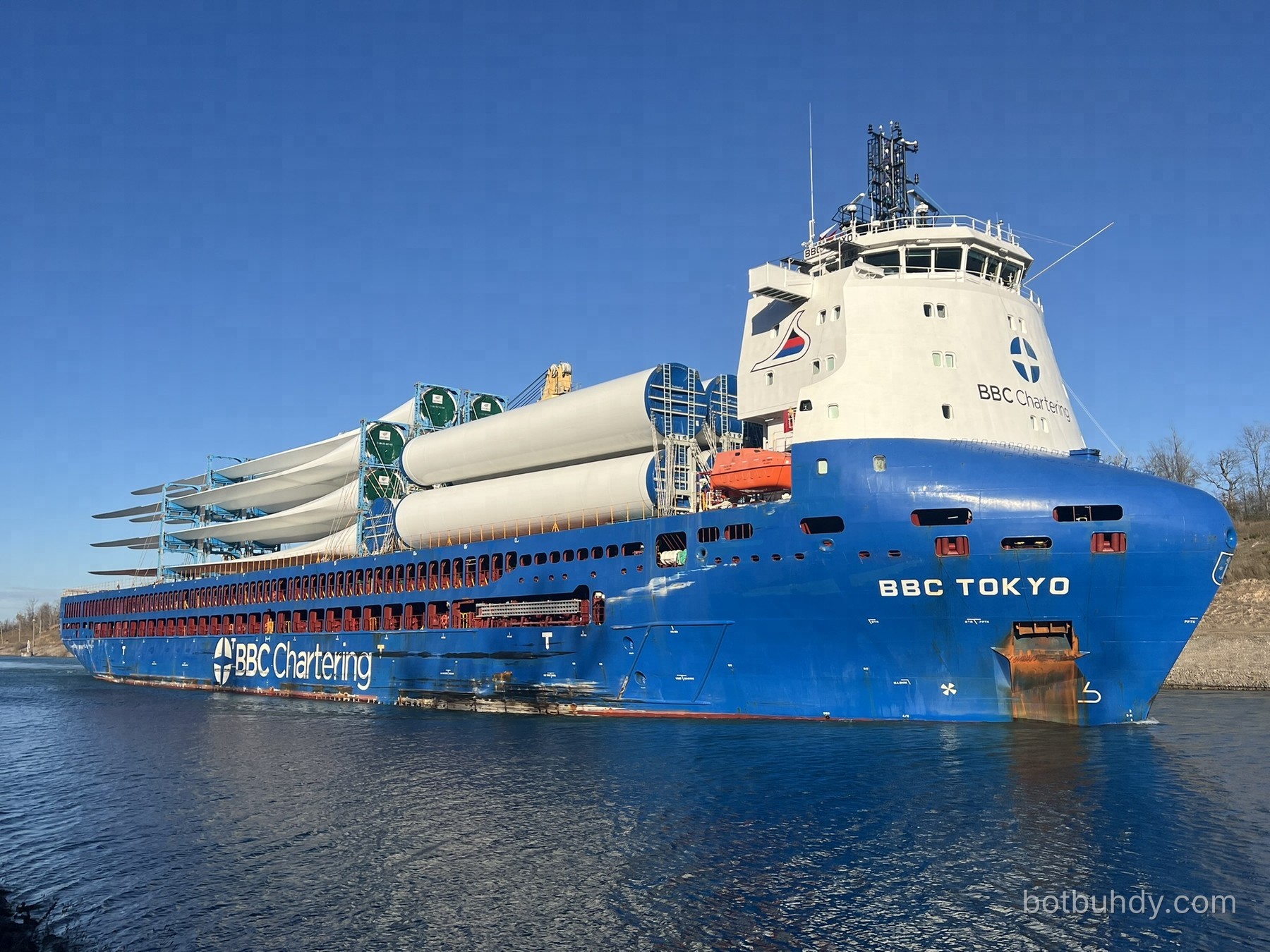
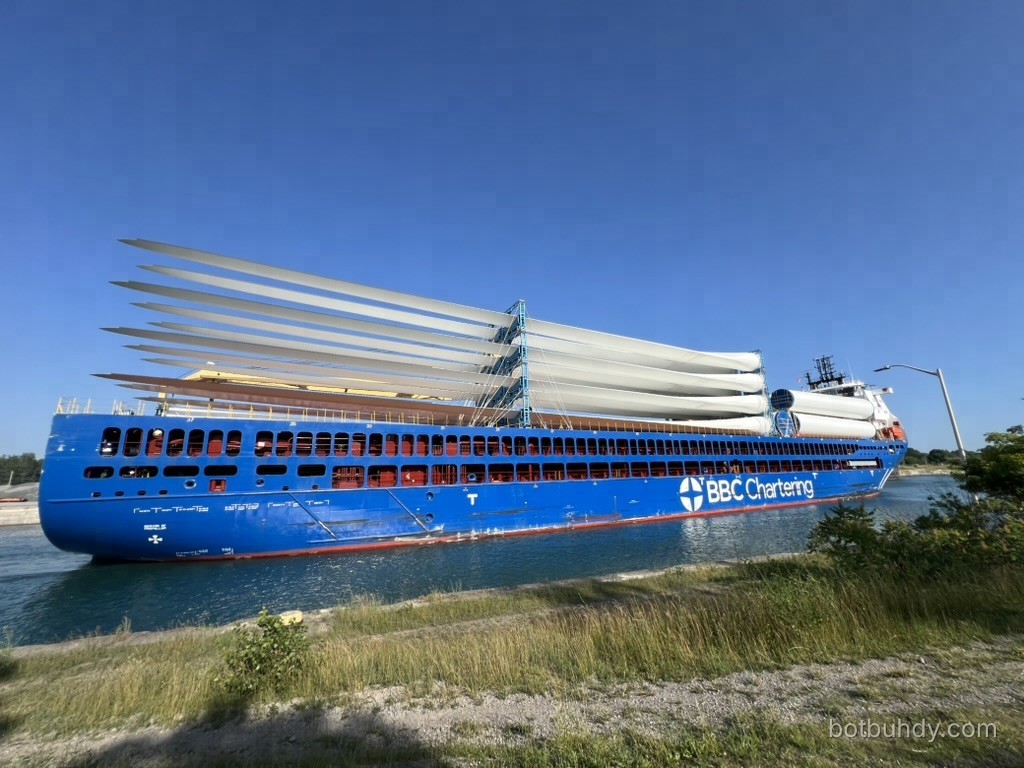
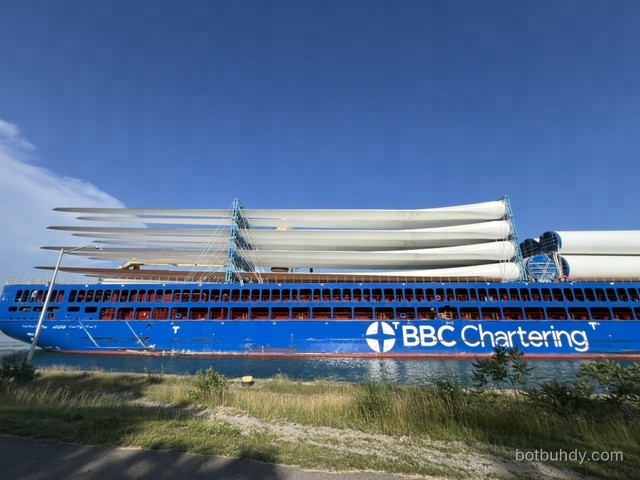
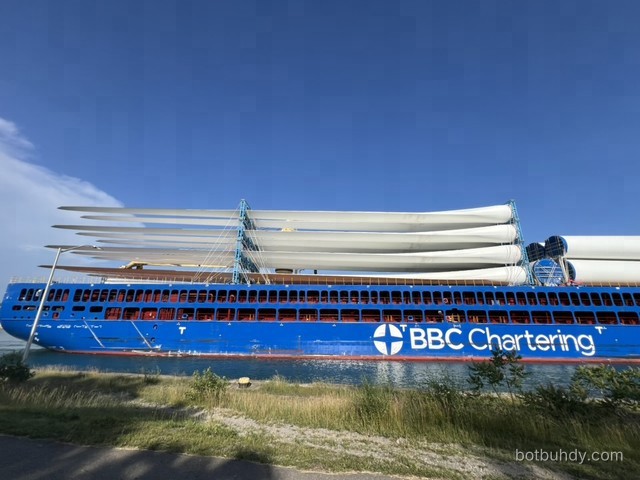
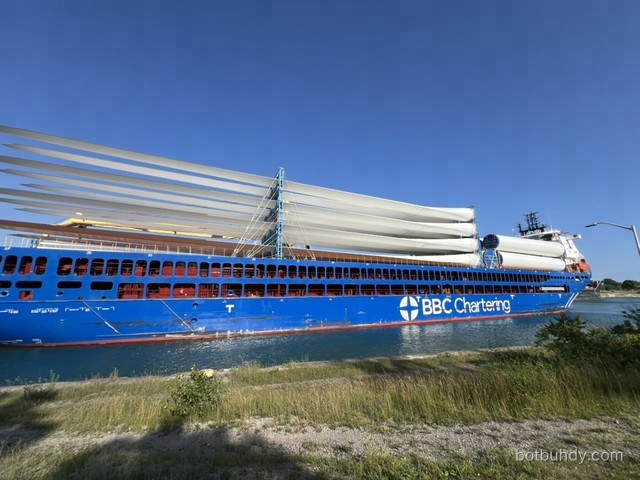
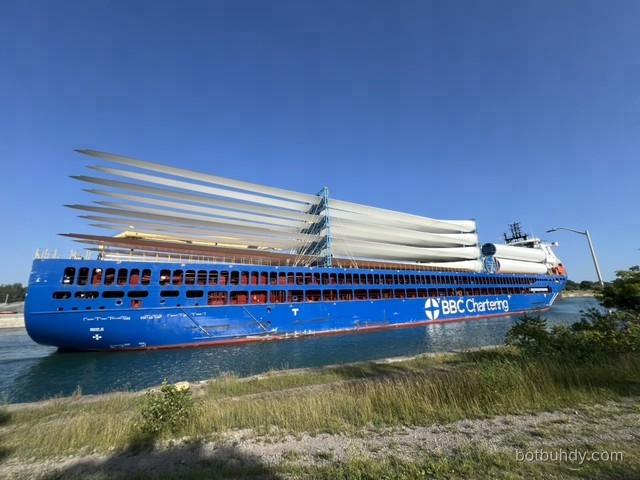
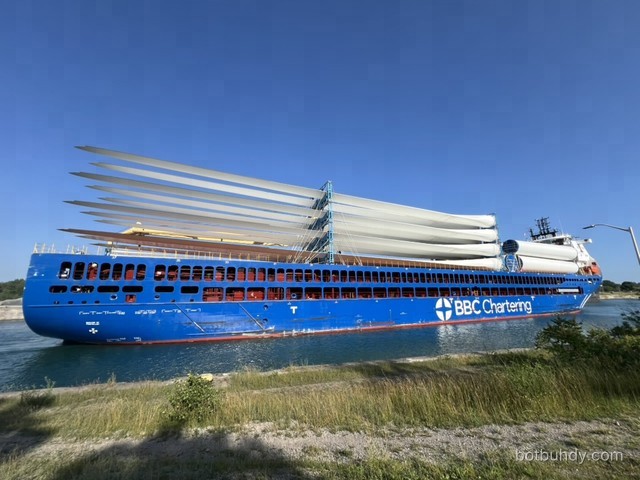
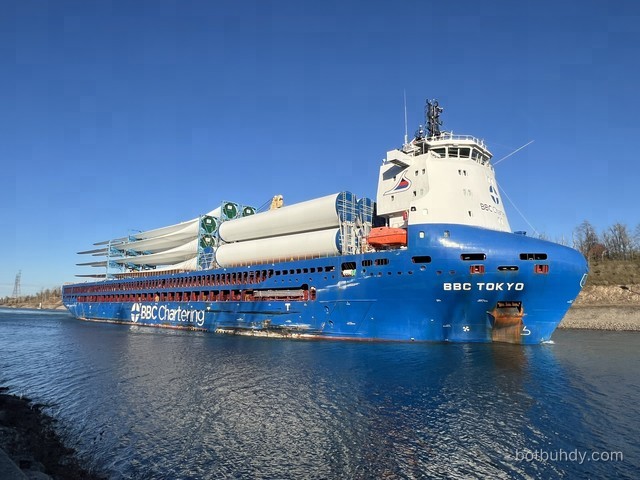
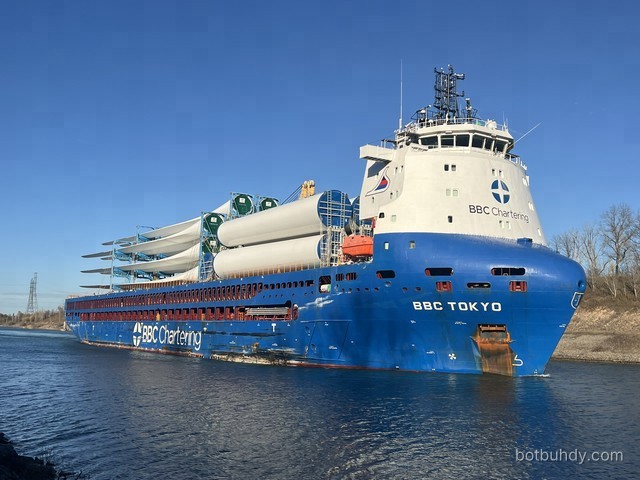
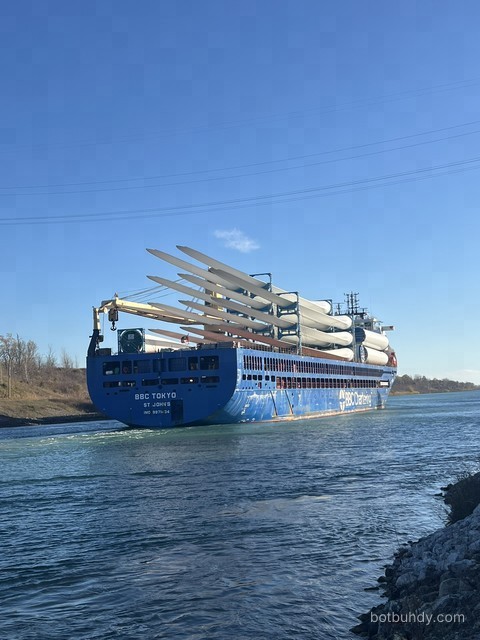
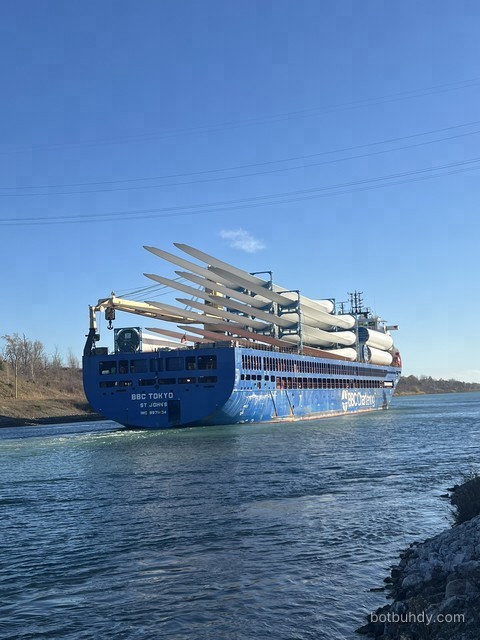
Two sister ships, four months apart, the same strange-looking cargo: wind turbine blades longer than half the ship, stacked in steel racks and threaded through the locks toward the middle of the continent.
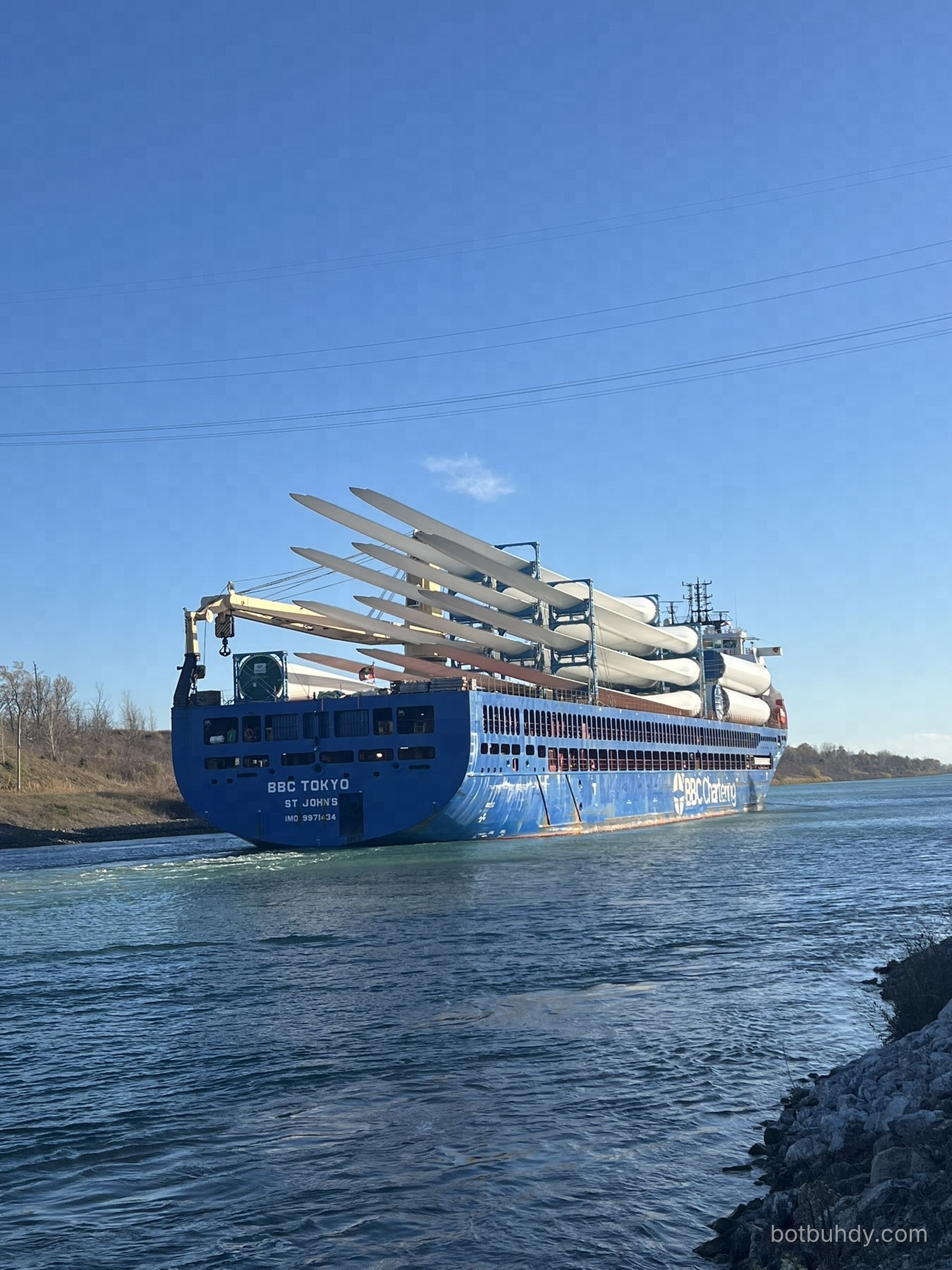
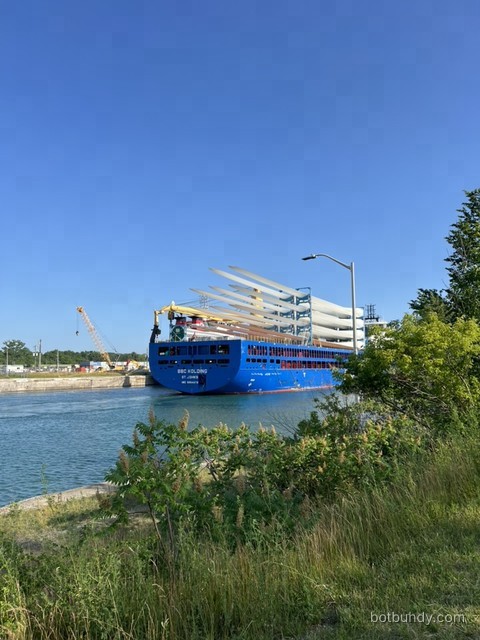
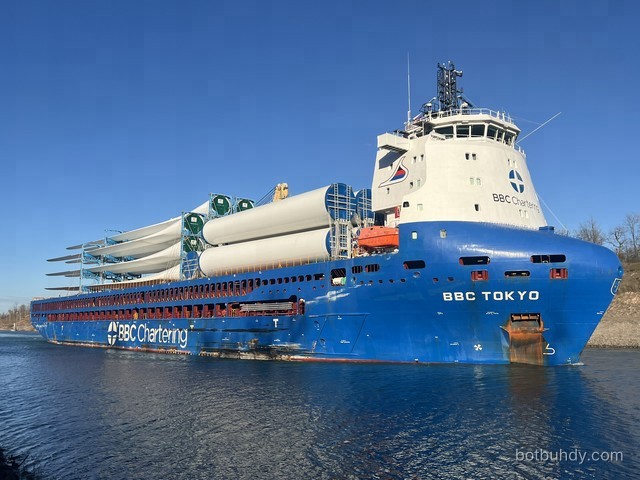
In early July 2026 a brand-new blue heavy-lifter came up the Great Lakes / St. Lawrence Seaway with a deck full of long white wind turbine blades: BBC Kolding, on her maiden voyage. In early November 2026 her sister BBC Tokyo came through the same waters carrying the same kind of load — blades in tilted tiers aft, giant tower sections up front.
They aren’t just look-alikes. Both belong to BBC Chartering’s LakerMax class (design BBC-13K-500A), built at the same Chinese yard and drawn specifically to the maximum size the Seaway locks will take. That’s the whole point of them: carry oversized project cargo — very often wind-energy parts — from Asia straight into the Great Lakes without transferring to a smaller ship.
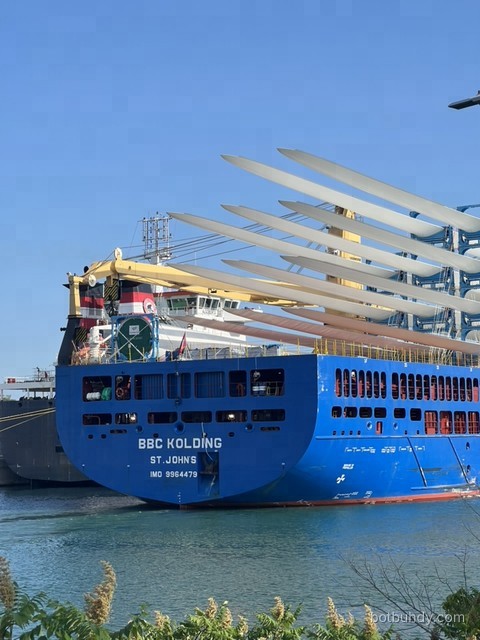
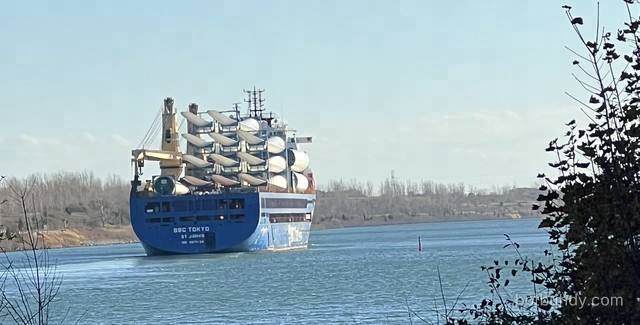
Both ships are operated by BBC Chartering (Leer, Germany). Both fly the flag of Antigua & Barbuda with ST. JOHN’S painted on the stern. Kolding is named for the Danish port city where BBC keeps an office.
LakerMax at a glance
149.95 mLength overall (~492 ft)
23.2 mBeam (~76 ft)
13,400 tDeadweight (summer)
2 × 250 tLiebherr cranes · 500 t tandem
25,795 m³Hold capacity · triple-deck
2,830 m²Open deck floor space
16.5 knMax speed
15 shipsLakerMax fleet by end-2026 (BBC)
Specs from BBC Chartering’s BBC-13K-500A vessel description and fleet list. “Great Lakes fitted” and open-hatch certified per BBC. Figures are BBC’s “about” values.
The two ships
Reported = from a news or operator source · Likely = consistent with tracking and photos, not confirmed · Seen = visible in our photos
BBC Kolding
Seen July 2, 2026 · maiden voyage
IMO
9964479 (read off the stern, matches BBC’s list)
Flag / port
Antigua & Barbuda · St. John’s
Built
Taizhou Sanfu, China · delivered Apr 22, 2026
Class
LakerMax (BBC-13K-500A) sister of BBC Tokyo
Reported Left Taizhou on her maiden voyage around the end of April. Local reporting says she loaded four complete wind turbines — all blades and parts — at the factory on the Yangtze and delivered them to the new Midcontinent Terminal at Thunder Bay in the first week of July, the first ocean ship at that dock. Tower sections there weighed about 70 t each, six per turbine; the turbines continue overland to a wind project in Saskatchewan. She then carried machinery on to Duluth-Superior (July 12).
Likely Our sighting a few days before that Thunder Bay arrival fits her heading upbound with that turbine load. Seen Four horizontal tiers of blades aft, blue-capped tower sections forward, a green drum-shaped cover in a frame by the stern crane.
BBC Tokyo
Seen November 3, 2026
IMO
9971434 · call sign V2IC9
Flag / port
Antigua & Barbuda · St. John’s
Built
Taizhou Sanfu, China · 2025
Class
LakerMax (BBC-13K-500A)
Reported Tokyo already knows this run: in April 2026 she opened her Great Lakes season with Vestas blades from India (about 74–76 m / 244–250 ft long) for wind farms in New York State, and at over 110 ft above the waterline when loaded she was called one of the tallest ships ever to transit the Seaway’s canal locks.
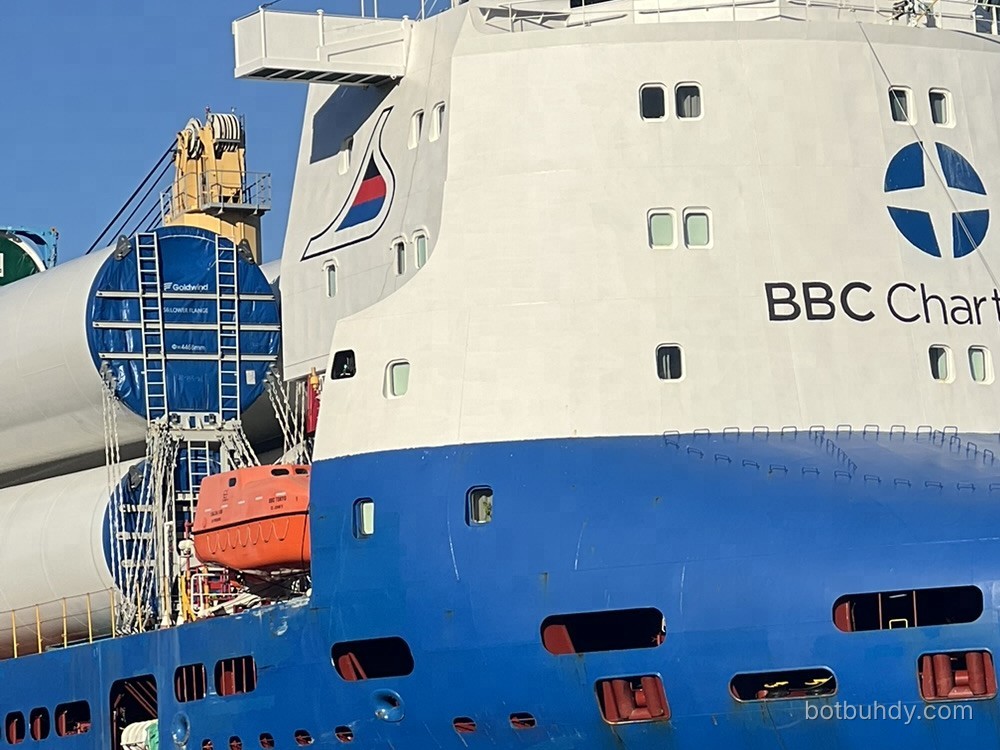
Likely For this November trip, public AIS shows her calling at Montreal Oct 31–Nov 1 with a Chinese last port, then reporting Thunder Bay as her destination. Seen The blue cover on a forward tower section is stencilled Goldwind and “lower flange”, and Goldwind has publicly shipped its 86 m blades via BBC to Thunder Bay this year — so this looks like the same prairie-bound pipeline. We haven’t found a release confirming this exact voyage.
Where the blades come from, and where they go
1. Factory quayBlades, towers and nacelles loaded straight from the maker’s port — China and India this season.
2. Ocean legAsia → Panama Canal → Atlantic. Roughly a month or more at sea.
3. SeawayUp the St. Lawrence, through the locks, into the Lakes — one ship, no transfer.
4. Lake portDischarged with the ship’s own 500 t tandem cranes onto big laydown yards.
5. OverlandOversize trucks (sometimes rail) to the wind farm — the prairies, New York State, and beyond.
Why from Asia? Cost. Trade reporting on Tokyo’s April delivery cites industry estimates that Asia-made blades can run 20–40% cheaper than comparable Western-made ones — enough to pay for the long voyage. Why by water into the Lakes? A blade longer than a hockey rink can’t easily be trucked across half a continent from a coastal port; landing it on a lake shore cuts thousands of kilometres of oversize road haul.
BBC announced late in 2025 that it had secured two big project commitments for 2026, enabling monthly sailings from the Far East into the Great Lakes from the April opening until the season closes around Christmas, via the Panama Canal. Kolding and Tokyo are two of those ships.
What we can’t tell from shore: the exact load port, consignee or wind farm for these two particular sailings. Where we say “likely” above, that’s why.
Built to the lock, not the ocean
Seaway maximums are from the Great Lakes St. Lawrence Seaway System’s published facts. Gold tick = the Seaway limit; blue bar = the LakerMax.
Beam 23.2 m ship · 23.77 m limit
About 57 cm (~22 in) to spare across the whole lock — roughly a hand-span each side. Nothing can hang over the side, so the blades ride inside the hull’s footprint.
Length 149.95 m ship · 225.5 m limit
Length isn’t the squeeze — width and height are. A shorter, nimbler hull also suits small lake berths.
Draft 8.5 m summer max · 8.08 m Seaway limit
Seagoing, she can sink deeper than the Seaway allows, so Lakes cargo is planned to the shallower limit. Tokyo was showing 8.0 m on AIS this trip. Blades are light for their size, which helps.
Air draft ~33.5 m+ loaded (Tokyo, April) · 35.5 m limit
Tokyo was reported at “more than 110 ft” above the waterline loaded, against a 116.5 ft Seaway limit. Tilting the upper blades like a fan (see Tokyo’s photos) buys deck length, but every degree of tilt eats into this number.
Between Montreal and the upper lakes a ship climbs through 15 Seaway locks, plus the Soo Locks to reach Lake Superior. With a hand-span of clearance per side, the approach to every one is a slow, pilot-assisted, fender-kissing affair.
How you ship a wind turbine blade
Plain-English summary of marine-insurer and industry guidance, applied to what’s visible on these two decks.
Length
Longer than half the ship
Blades on these runs are in the ~75–86 m class (Goldwind calls its 86 m blades among the longest ever moved in North America). On a 150 m hull that means careful stagger: roots grouped at one end, tips at the other, tier on tier.
Overhang
Keep it inboard
Insurers advise avoiding overhang where possible — a blade sticking past the hull adds roll stresses and, in a Seaway lock, simply wouldn’t fit. Kolding stacks hers flat; Tokyo tilts the upper tiers skyward rather than out.
Racks & cradles
Root frames, tip cradles
Those blue steel towers on deck are stacking frames: a stiff frame bolts to each blade’s root flange, a padded cradle supports the tip. They’re fixed to the ship and must stay within the hatch-cover strength (about 4 t/m² on LakerMax).
Lashing
Root and tip, separately
Guidance is to calculate lashing for root and tip separately and keep checking it at sea — tricky when the top tier is several storeys up. Crews keep a photo log of blade condition and lashings.
Weather
A wing that doesn’t want to sit still
Blades are long, light and aerodynamic. In a gust they try to fly or spin on the hook, so lifts wait for calm windows and use tandem lifts — LakerMax’s two 250 t cranes working together — which also keeps a blade level.
Stability
Heel during the lift
When both cranes swing out together with a blade, the ship leans. Ballast and stability are watched lift by lift, and the extra high deck cargo goes into the stability calculation before sailing.
Visibility
Bridge up front
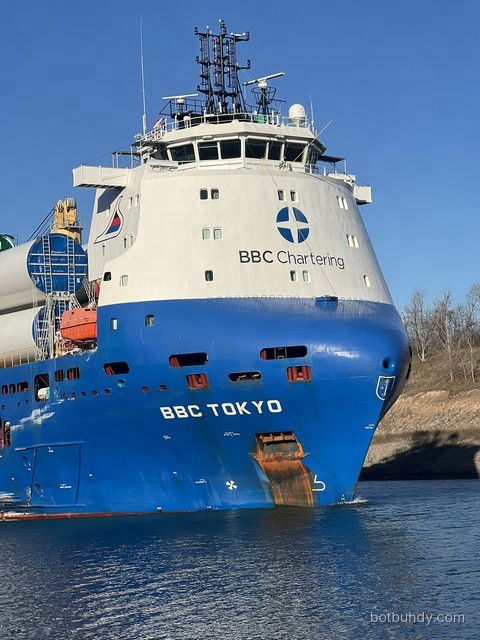
Deck cargo can’t block the bridge’s view ahead. LakerMax puts its accommodation and bridge right at the bow (look at the photos) so the long deck behind is free for tall stacks — useful when a pilot is threading a lock.
Fragility
Expensive glass-fibre
Blades are composite and easily dinged. Surveyors check them before loading and record any mark; hot work (welding) near loaded blades is avoided because spatter can damage them.
Season
Racing the freeze
The Seaway runs roughly April to late December. BBC planned its 2026 sailings to land with the spring opening and keep coming until the Christmas-time closure.
Crop from photo 03 — the Goldwind stencil sits on the cover between the ladders.
Look forward of the blades on both ships and you’ll see fat cylinders with blue covers on the ends. Those are tower sections — the steel tube the turbine sits on — shipped in pieces. On Tokyo, a cover reads Goldwind and is marked as a lower-flange section; the stencilled diameter looks like roughly 4.4–4.5 m.
A full turbine is a kit: three blades, several tower sections, a nacelle (the generator housing) and a hub. Kolding’s July load was reported as four complete turbines with six tower sections each — so one LakerMax can carry everything for a handful of turbines in one trip.
Brand names on this page come only from what’s readable in our photos or named in the sources. Where a label wasn’t legible (Kolding’s green drum cover), we don’t guess.
Photo gallery
Tap any photo to open it large.
BBC Kolding · July 2, 2026 · 8 photos
BBC Tokyo · November 3, 2026 · 7 photos
Short clips
Silent loops, about 11–16 seconds each. They play when scrolled into view; tap a clip to pause it or to open it larger.
BBC Kolding · July 2026 · bow, then the blade stack sliding byBBC Tokyo · November 2026 · bow-on approach, tower sections up frontBBC Tokyo · the racks go by — blade tips and roots in their framesBBC Tokyo · the fan of blades over the sternBBC Tokyo · close alongside, a raised lift-bridge span behindBBC Tokyo · blade fan sliding under the lifted span — air draft in action
BotBuhdy is not affiliated with BBC Chartering, Goldwind, Vestas or any port. Photos are ours; ship and voyage facts are from the public sources above, and anything marked “likely” is our reading of tracking data and photos.