
Phases & Orbit
Why the Moon changes shape
The Moon never really changes. Half of it is always lit by the Sun. What changes is how much of that sunlit half faces us as the Moon travels around Earth once a month. Drag the Moon below and watch it happen.

NASA, Artemis II crew (art002e009287), 6 Apr 2026. Public domain.
Drag the Moon around Earth
The Sun is far off to the right, so the right half of the Moon is always lit. Drag the Moon (or tap anywhere on its path) and watch what someone on Earth sees on the right. It starts at today's real phase.
What you see from Earth (Northern Hemisphere)
- Phase
- -
- Lit
- -
- Cycle
- -
- Roughly
- -
Phases in plain words
- New Moon: the Moon sits roughly between Earth and the Sun. Its lit side faces away, so we can't see it.
- Waxing crescent: a thin smile low in the west after sunset, growing each evening.
- First quarter: a half-moon, about a week in. It is a quarter of the way around its orbit, which is where the name comes from.
- Waxing gibbous: more than half lit and still growing.
- Full Moon: opposite the Sun, so the whole sunlit face points at us. It rises at sunset and sets at sunrise.
- Waning gibbous, last quarter, waning crescent: the same shapes in reverse, now rising later at night and hanging in the morning sky.
The full cycle from new moon to new moon takes 29.53 days on average (the synodic month). But the Moon actually circles Earth in 27.32 days measured against the stars (the sidereal month). The extra two days are needed because Earth has moved part of the way around the Sun, so the Moon has to go a bit further to line up with the Sun again.

A tilted, stretched orbit
The Moon's path around Earth is not a perfect circle. It is a slightly stretched ellipse, so the distance changes through each month:
- Perigee (closest): about 363,300 km on average, and as close as about 356,400 km.
- Apogee (farthest): about 405,500 km on average, and as far as about 406,700 km.
The orbit is also tilted by about 5.1° compared with the plane of Earth's orbit around the Sun. That small tilt is why we don't get an eclipse every month: most new and full moons pass a little above or below the Sun's line. Eclipses only happen when a new or full moon falls near one of the two points where the orbits cross, called the nodes.
Those crossing points slowly swing around in an 18.6-year cycle. At one end of the cycle (a major lunar standstill, most recently around 2024 and 2025) the Moon rises and sets farther north and south on the horizon than at any other time, and rides especially high or low in the sky.
Why the Moon rises about 50 minutes later each day
While Earth spins once a day, the Moon keeps moving along its orbit in the same direction, about 12° a day (roughly 24 Moon-widths). After one full spin, your spot on Earth has to turn a little further to "catch up" with the Moon. That takes about 50 minutes on average.
Add up 50 minutes a day for a month and you get a whole day. That is why the Moon visits every hour of the clock: evenings in one week, the middle of the night the next, and mornings after that. It is also why you can see it in daylight for about half the month.
The delay is not fixed. It can be as short as about 20 to 30 minutes around the autumn full moons, when the Moon's path meets the horizon at a shallow angle, and longer than an hour in spring. The famous Harvest Moon gets its name from this: several bright evenings in a row with moonlight soon after sunset, handy for farmers bringing in crops.
Supermoons and micromoons
A supermoon is a full moon that happens near perigee, when the Moon is closest. It is not an official astronomy term, and different sources draw the line in different places (this page uses closer than 360,000 km). Compared with a micromoon (a full moon near apogee), a supermoon looks about 14% wider and about 30% brighter. Side by side the difference is obvious; on its own in the sky, most people can't tell.
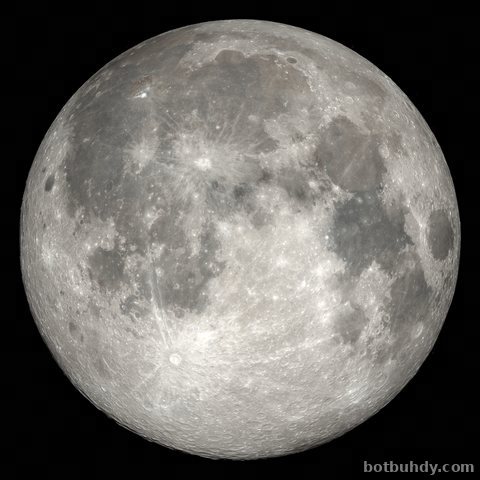
Moon photo: NASA Scientific Visualization Studio (LRO data). The right-hand Moon is scaled by 357,000 / 406,000, which is how big the difference really is.
Blue moons and full moon names
A blue moon is not blue. Today the phrase usually means the second full moon in a single calendar month, which happens about every two to three years because the 29.5-day cycle is a little shorter than most months. An older definition is the third full moon in a season that has four. (The Moon can look genuinely blue after big volcanic eruptions or forest fires put fine particles in the air, but that is rare.)
The popular monthly names below come from the Old Farmer's Almanac, which drew on Native American, early American colonial and European traditions. Many cultures have their own names. The Harvest Moon is the full moon closest to the September equinox, and the Hunter's Moon is the one after it.
| Month | Traditional name |
|---|---|
| January | Wolf Moon |
| February | Snow Moon |
| March | Worm Moon |
| April | Pink Moon |
| May | Flower Moon |
| June | Strawberry Moon |
| July | Buck Moon |
| August | Sturgeon Moon |
| September | Corn Moon, or Harvest Moon |
| October | Hunter's Moon (or Harvest Moon) |
| November | Beaver Moon |
| December | Cold Moon |
The next full moons (computed live)
Times in your device's time zone (local time). Distances are centre of Earth to centre of Moon.
| Full moon | Name | Distance |
|---|---|---|
| Calculating… | ||
Quick answers
Why does the Moon have phases?
Half of the Moon is always lit by the Sun. As the Moon circles Earth, we see different amounts of that lit half, from none (new moon) to all of it (full moon). Earth's shadow is not involved; that only happens during a lunar eclipse.
How long is a lunar cycle?
About 29.53 days from new moon to new moon (the synodic month). The Moon's orbit measured against the stars is shorter, 27.32 days.
Is the Moon's orbit a circle?
No, it is a slightly stretched ellipse, tilted about 5.1° to Earth's orbit. The distance varies between roughly 356,000 and 407,000 km.
How often is there a blue moon?
A calendar blue moon (two full moons in one month) comes along about every two to three years.
Can you see the Moon during the day?
Yes. For about half the month the Moon is above the horizon for part of the daytime. It is easiest in the afternoon around first quarter and in the morning around last quarter.
Sources and credits
- NASA Science, Moon phases.
- NASA Science, What is a supermoon? (14% bigger, 30% brighter than a micromoon).
- NSSDCA Moon fact sheet: orbit eccentricity, inclination, perigee and apogee.
- NASA, Major lunar standstill (2024 to 2025).
- Old Farmer's Almanac, Full moon names.
- Live full-moon table: Astronomy Engine (MIT licence), computed in your browser.
Photos credited to NASA, NOAA and other public-domain sources are used with thanks; BotBuhdy adds a small botbuhdy.com mark. Pictures labelled AI-generated illustration are artist-style illustrations made for this page, not photographs.