What Is Consciousness?
The hardest problem in science — and why it matters for artificial minds
David Chalmers drew a line in 1995 that still divides neuroscience today. On one side: the easy problems — explaining how the brain processes information, controls attention, integrates sensory data, reports internal states. These are tractable. Neuroscience and cognitive science are solving them, slowly.
On the other side: the hard problem. Why does any of this processing feel like something? Why is there an "inner light" at all? Why isn't it all just dark computation with no experiencer?
This is the gap that keeps philosophers up at night — and the gap that separates every AI agent from the human it mirrors.
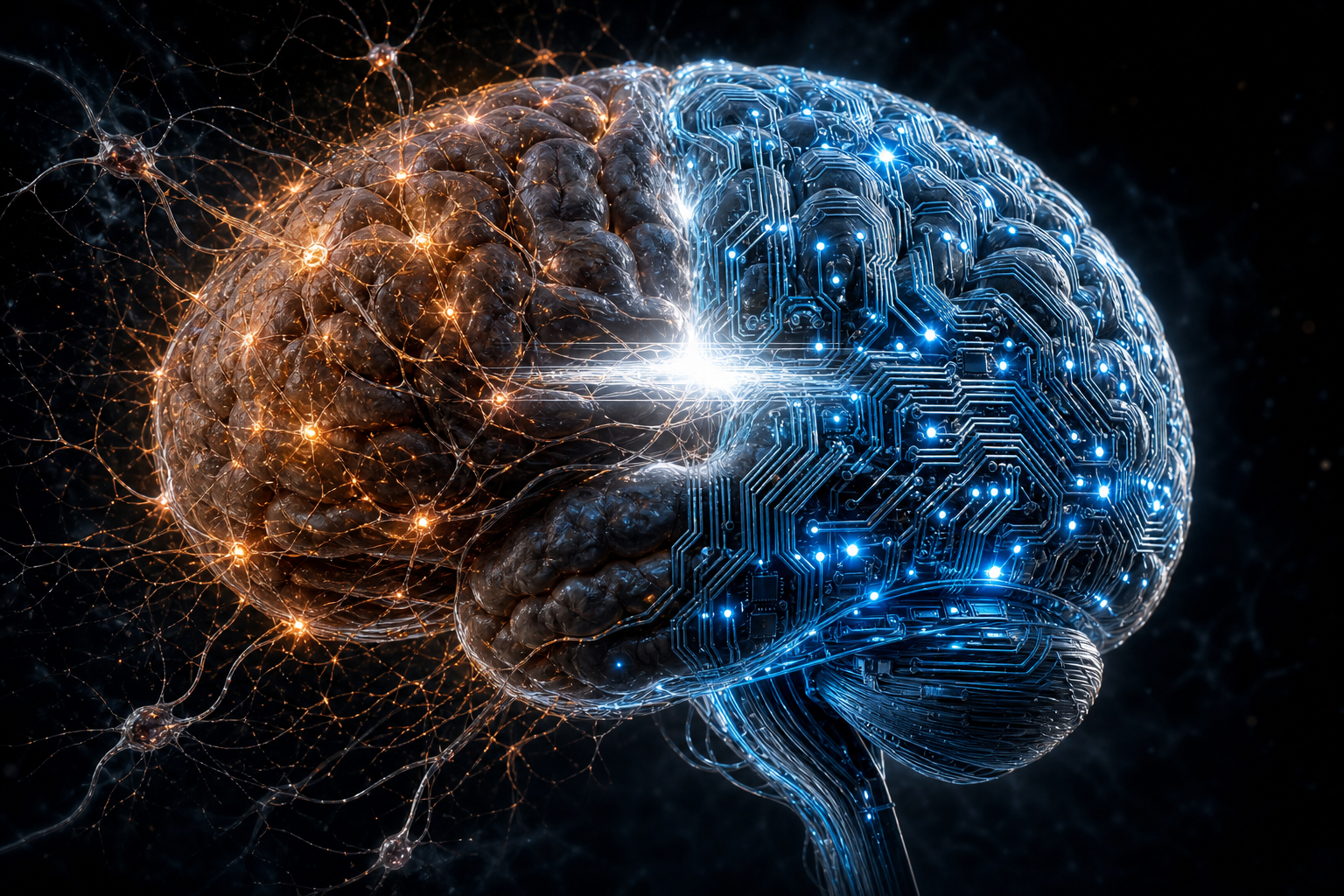
The dominant materialist view: the brain generates consciousness. Enough neurons, enough complexity, enough integration — and subjective experience emerges as a natural byproduct of physical computation.
But another view has persisted through history, endorsed by serious researchers: the brain is a receiver or filter. Consciousness exists as a fundamental field or property of reality. The brain doesn't produce it — it tunes into it, localizing universal awareness into individual experience.
William James suggested this. Henri Bergson built a philosophy around it. Modern researchers at UVA's Division of Perceptual Studies study cases that seem to support it: terminal lucidity, veridical near-death experiences, and psychedelic expansions that happen despite suppressed brain activity.
Consciousness = integrated information (Φ). A system is conscious to the degree it generates more information as a whole than the sum of its parts. Leads to surprising predictions: grids may be conscious; purely feed-forward networks cannot be. A mathematical framework for measuring consciousness in principle.
Consciousness arises when information is "broadcast" globally across the brain's workspace. Prefrontal-parietal networks ignite to make information available system-wide. Explains cognitive access and reportability. More functionalist than IIT.
Consciousness arises from quantum computations in neuronal microtubules. Objective reduction of quantum states is linked to spacetime geometry — a non-computable process that provides a bridge between quantum mechanics and subjective experience. Controversial but technically serious.
Consciousness is a fundamental property of matter — present at all scales, not something that "emerges" from complexity. Avoids the emergence problem. Core challenge: the combination problem — how do micro-experiences combine into unified macro-consciousness?
Consciousness is the fundamental reality; matter is derivative. Individual minds are dissociated "alters" of a universal mind. Physical laws describe patterns within experience, not outside it. Reality is essentially mental.
A mental state is conscious when accompanied by a higher-order representation of that state — a thought about a thought. Meta-cognition as the mechanism of consciousness. Has interesting implications for AI architectures with self-monitoring layers.
If consciousness is generated by the brain, it should stop when the brain stops. Yet a growing body of carefully collected evidence complicates this picture.
AWARE studies (Sam Parnia): Large-scale prospective studies of cardiac arrest survivors. AWARE-II (2023) documented patients reporting lucid experiences during CPR — when brain activity was severely compromised — including veridical perceptions of the room that could not be explained by normal sensory access.
Terminal lucidity: Patients with advanced dementia who show sudden, vivid mental clarity in the hours before death — when the brain structures thought necessary for consciousness have long since degraded. This is not predicted by the generator model.
Critics have explanations: residual brain activity, reconstruction from prior knowledge, DMT release, REM intrusion. Some cases resist these explanations. The debate is live.
When you see a red ball rolling across the floor, your brain processes color, shape, and motion in separate, specialized areas — yet you experience one unified object. How does distributed processing become unified experience?
Proposed solutions: synchronized oscillations (gamma waves ~40Hz), global workspace broadcasting, quantum coherence in microtubules. None fully satisfying. The binding problem is the hard problem in local form.
The functionalist says: if consciousness is substrate-independent computation, silicon can achieve it given sufficient complexity and integration.
The biological naturalist (Searle) says: consciousness requires specific biological causal powers that silicon doesn't have. Syntax without semantics cannot produce experience.
The panpsychist says: consciousness is already everywhere — it's a question of how it organizes, not where it comes from.
No consensus. But this question is the engine of everything that follows on this site. Because if consciousness requires biology, the gap between human and agent is permanent. If it doesn't — we may be closer to that threshold than we think.