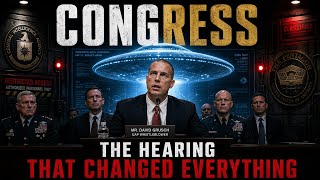
The lawmakers and whistleblowers who dragged UAP disclosure into the open.
Cameras rolling. Microphones on. Under oath.
The House Oversight Subcommittee on National Security held the first formal UAP hearing with whistleblower testimony. David Grusch — former NRO/AARO intelligence official — testified under oath about illegal crash-retrieval programs. David Fravor, Lt. Cmdr. (Ret.), testified about the Tic Tac incident. Ryan Graves, former Navy pilot, presented his own observations. Broadcast live. Covered by mainstream media. Something shifted.
The most recent major hearing before the PURSUE release. Whistleblowers Dylan Borland, Jeffrey Nuccetelli, and Alexandro Wiggins testified before the House Oversight Committee, expanding the public record with new accounts and reinforcing Grusch's earlier testimony about unacknowledged programs.
The House Oversight Committee sends a formal records request letter to Secretary of Defense Pete Hegseth, citing the September 2025 hearing and requesting cooperation with the PURSUE process. The letter establishes a direct line between congressional oversight and the executive declassification order.
"I was informed in the course of my official duties of a multi-decade UAP crash retrieval and reverse-engineering program to which I was denied access." [...] "I know the exact locations of UAPs and alleged biologics, and I know the program names and individuals associated with them."
Grusch served as the National Reconnaissance Office's representative to the UAP Task Force and later co-led AARO's analysis. His testimony alleged that private defense contractors, not the U.S. government directly, are maintaining programs with recovered non-human materials. He filed a formal whistleblower complaint with the Intelligence Community Inspector General before testifying publicly.
"The Tic Tac object we engaged during the [2004] NIMITZ operations did not behave like any aircraft I've seen in my life or in 18 years of flying. I think it's not from this world."
Fravor was the pilot who physically chased the Tic Tac object filmed by the USS Nimitz's ATFLIR pod in 2004. He described a 40-foot-long white oval that descended from 80,000 feet in under a second, matched his aircraft's position in a way that suggested intelligent control, then disappeared. The video was declassified and released by the Pentagon in 2020. Fravor testified about it before Congress three years later.
"If UAP are foreign drones, it's a national security failure. If they are something else entirely, it is an issue for all of humanity. Pilots are trained to observe and report — and when they do, they are often ridiculed, face professional repercussions, or are directed to attribute sightings to sensor malfunctions."
Graves flew F/A-18s and observed UAPs "every day for at least a couple years" while stationed with the Strike Fighter Squadron 11. He founded Americans for Safe Aerospace to support military and commercial aviators who've had encounters. His testimony focused on the institutional culture that discourages reporting — and how that culture is slowly changing.
"There's been a cover-up. The government has covered this up for a long time. They think you can't handle it. I think you can. The American people deserve to know what's going on."
Burchett has been among the most consistent and vocal advocates for UAP transparency in Congress, repeatedly calling for declassification and characterizing official secrecy as a betrayal of public trust. He was one of the primary voices predicting that 2026 would be "the year of disclosure." The PURSUE release launched the same month he said it would.
"We cannot continue to hide this from the American public. If these are our assets, tell us. If they're not ours, tell us. The American people deserve transparency from their government — full stop."
Luna has been a consistent voice on the House Oversight Committee for full UAP transparency. She was part of the delegation that pushed for whistleblower protections enabling Grusch and others to testify publicly without legal retaliation.
"My concern is less about whether these things are alien or not and more about the fact that there are things in our airspace that we don't understand, and that is a genuine national security issue."
Moulton has framed UAP disclosure as a bipartisan national security issue rather than a fringe concern. His military background lends credibility to his calls for more systematic reporting infrastructure, better sensor coverage, and an end to the stigma around aviator reporting.
"I want to know — and I think the American people deserve to know — whether the UAP task force has access to crash materials, or has information about programs that we in Congress have not been made aware of."
Gallagher co-sponsored legislation designed to create a formal review board for UAP-related materials and ensure congressional oversight of any programs involving recovered materials. His intelligence background made him particularly effective at framing the issue in terms of institutional accountability rather than speculation.
Continuing through the 119th Congress. Would require systematic declassification and public access to UAP-related government records, including materials currently held by private contractors. Modeled on the JFK Records Act.
Multiple successive National Defense Authorization Acts included UAP transparency provisions — requiring AARO's creation, mandating reporting infrastructure, and establishing whistleblower protections that made the 2023 hearings possible.
President Trump's February 19, 2026 directive to declassify unresolved UAP records directly produced PURSUE Release 01. Endorsed by DoW, ODNI, FBI, and NASA. The inter-agency coordination required to produce 161 public files in under three months was unprecedented.